

Feminist Explorations
In search of greatness. And nuance.

A funny thing often happens with groundbreaking insights that famously thrust themselves into that murky domain known as “the public consciousness”. They captivate so many people, so quickly, that they rapidly become substantially reworked and reinterpreted, rapidly ending up as quite different to how they were originally framed.
The first time I encountered Einstein’s original 1905 paper on special relativity, for example, I was shocked by the form of its argument that, in all its penetrating simplicity, was very differently expressed than how I had learned it some 80 years later. And while the many layers of elegant geometrical formalism that had accreted upon it over the decades unquestionably placed the theory’s key conceptual insights firmly within the larger domain of fundamental physics, they also, revealingly, “airbrushed away” key aspects of its pioneering spirit.
This sort of thing happens quite often in the humanities too. How many of us, unthinkingly relying upon some superficial bullet-point framework of a few characteristic insights of history’s most renowned thinkers (Plato believed X, Hume said Y, Kant responded with Z), find ourselves taken aback when we go to the original source material and discover numerous occasions when these celebrated authors express substantially different, much more nuanced, views than what we had naively expected.
Exactly this sort of thing happened to me when I finally got around to reading Linda Nochlin’s trailbrazing 1971 essay, “Why Have There Been No Great Women Artists?” 1
Somehow, unreflectively, I thought I knew what it was about: that centuries of a rigidly male-dominated societal structure was directly responsible for the palpable lack of accomplished women artists throughout history.
This is not, as summaries go, wildly off-base. And yet it so palpably lacks the vital nuance that makes this paper so deserving of being read.
After all, the idea that women, people of colour, and a whole host of others, have been actively, systematically, discriminated against for centuries is hardly a newsflash to anyone who’s been paying the slightest amount of attention to human history (or, for that matter, human present): How on earth could that not have led to a drastic diminishment of a wide range of potential cultural accomplishments, very much including, but by no means limited to, works of art?
And that, in short, is why it took me so long to get around to reading Nochlin’s article: why bother reading something that you already know? Well, that’s not entirely true: there were other reasons too. I’d often heard that this piece had done nothing less than “launch the discipline of feminist art history”, and the phrase “feminist art history” had long given me considerable pause, with its unsavoury combination of academic trendiness and obfuscating unintelligibility.2
I have an innate distaste for all such strongly agenda-driven academic movements – Marxist history, queer theory, neo-conservative economics – that seem tautologically designed to reveal far more of the dogmatic predilections of their investigators than any objective truths associated with their alleged subject matter. Indeed, many of these fashions are clearly premised on the notion that no such objective truth exists in the first place; and it seems pretty obvious to me that no meaningful middle ground can possibly occur with someone who clings to such a profoundly different notion of the research enterprise.
So I tend to steer very clear of the whole business; and for many years consequently gave “Why Have There Been No Great Women Artists?” a deliberate pass.
But that was a mistake, because it turns out that Nochlin’s article crackles with profound insights, from its initial invocation of John Stuart Mill3 , to its highlighting of specific training techniques, such as drawing nude models, that female artists were long denied access to, to a clear-eyed analysis of the societal trope of “feminine well-roundedness” that simultaneously redirected women from the single-minded pursuit of excellence while condescendingly framing their artistic accomplishments as mere dilettantism.
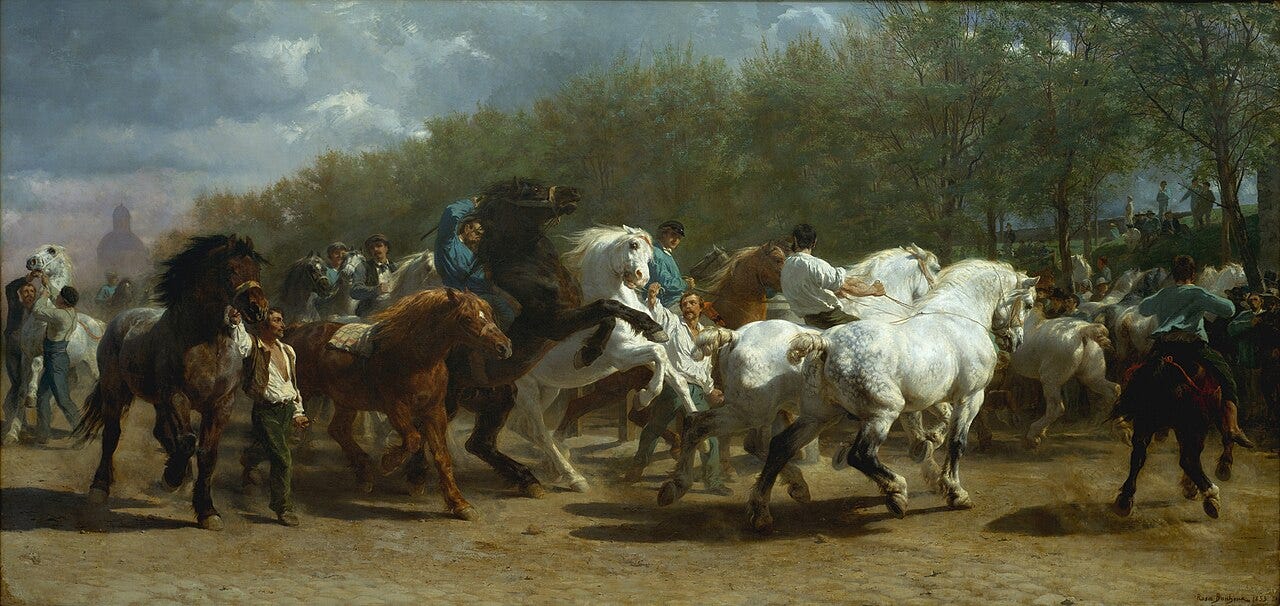
But for me, perhaps the most memorable aspect of “Why Have There Been No Great Women Artists?” is when Nochlin examines the case of Rosa Bonheur (1822-1899), a bonafide artistic success story who nonetheless was unable to escape the psychological torments of feeling compelled to routinely demonstrate her standard, societally imposed “feminine” qualities:
“The voice of the feminine mystique, with its potpourri of ambivalent narcissism and guilt, internalized, subtly dilutes and subverts that total inner confidence, that absolute certitude and self-determination, moral and esthetic, demanded by the highest and most innovative work in art.”
It is surely hard enough for any artist, in any circumstance, to martial the necessary self-belief to eventually triumph against the odds. That virtually all women, no matter how strongly supported they are by friends and family,4 are burdened with a significant additional layer of societally-imposed self-doubt, goes a considerable distance towards explaining why the number of truly great women artists is vastly less than it should be.
Because, vitally, Nochlin doesn’t deny that this is the case. This, too, was a surprise. I had naively expected that she would claim that there were many women painters whose artists accomplishments objectively ranked alongside their great male counterparts but, owing to our omnipresent gender biases, they’ve been systematically overlooked. But she does no such thing.
“The fact of the matter is that there have no supremely great women artists, as far as we know, although there have been many interesting and very good ones who remain insufficiently investigated or appreciated; nor have there been any great Lithuanian jazz pianists, nor Eskimo tennis players, no matter how much we might wish there had been.
“That this should be the case is regrettable, but no amount of manipulating the historical or critical evidence will alter the situation; nor will accusations of male-chauvinist distortion of history. There are no women equivalents for Michelangelo or Rembrandt, Delacroix or Cézanne, Picasso or Matisse, or even, in very recent times, for de Kooning or Warhol, any more than there are black American equivalents for the same.”
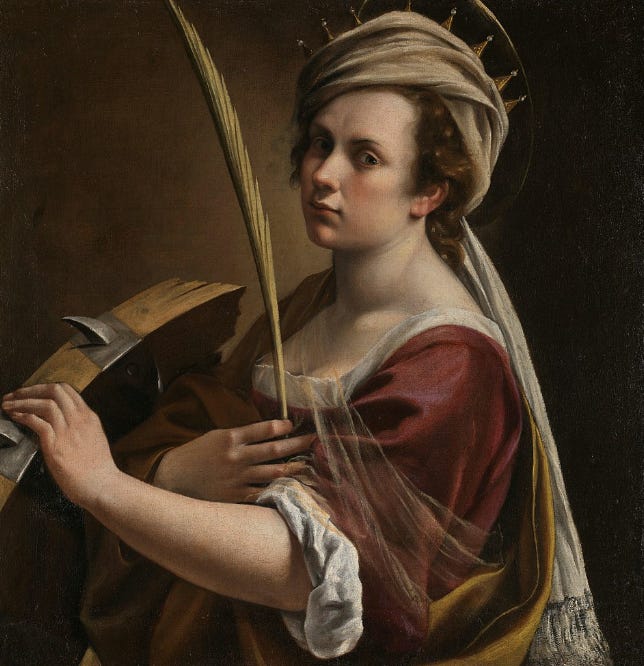
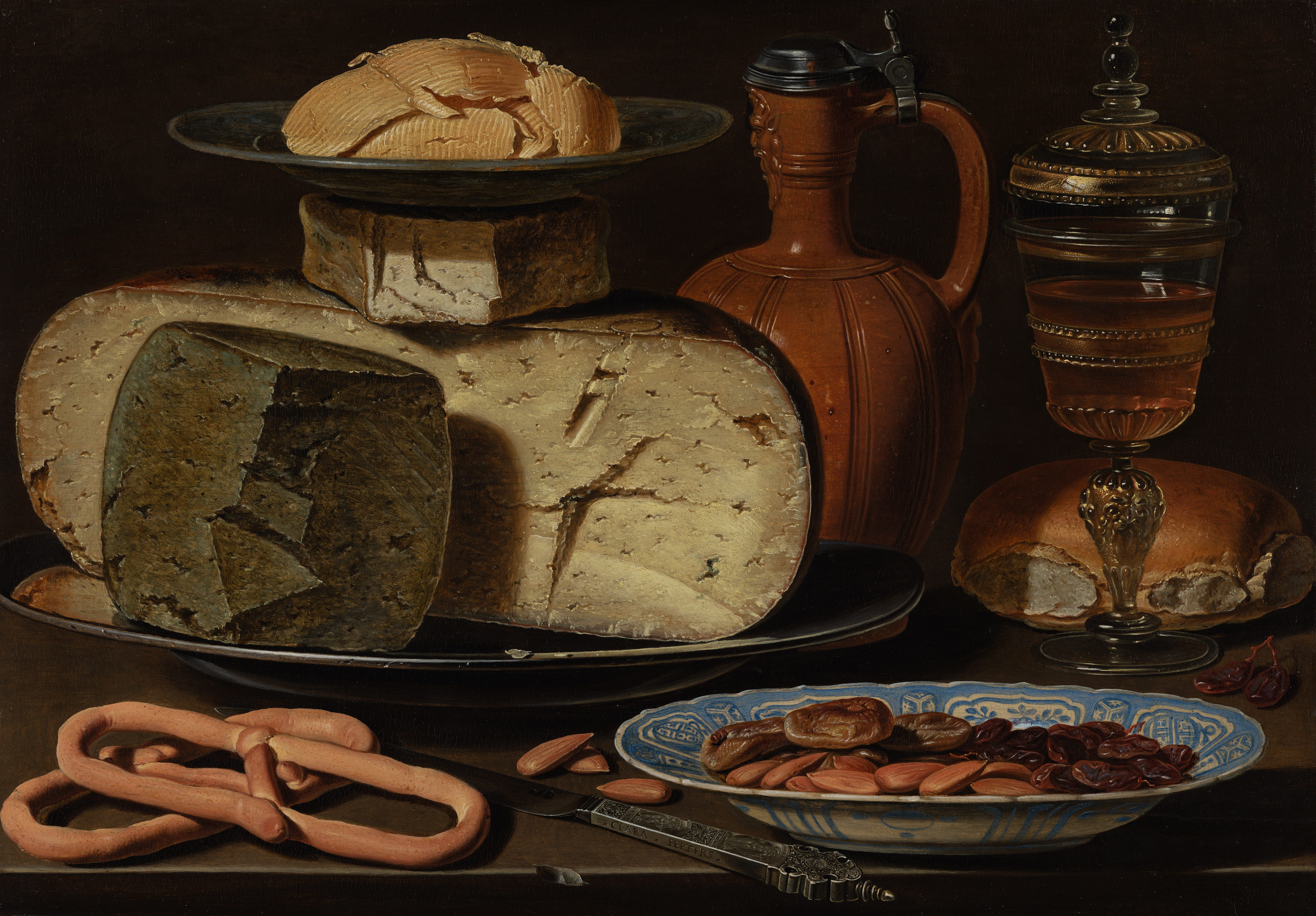
Somewhat ironically, this is the only one of Nochlin’s claims that didn’t entirely convince. I’ll unhesitatingly agree if one sets the bar at Michelangelo and Rembrandt, and perhaps at Cézanne, Picasso or Matisse, but personally, give me an Artemisia Gentileschi or a Clara Peeters over a de Kooning or Warhol any day. In my view, in other words, there have been lots of great women artists deserving of widespread appreciation. If we limited ourselves to just looking at the works of Michelangelo and Rembrandt, we’d run out of worthy subject matter pretty darned quickly.
As it happens, Nochlin herself played a seminal role in bringing many of these long-neglected painters to public prominence through the landmark 1976 exhibition at the Los Angeles County Museum of Art, Women Artists, 1550-1950, that she co-curated with Ann Sutherland Harris.5
Meanwhile, a steady outpouring of scholarly work, led by the likes of Mary Garrard, Elizabeth Cropper, Federika Jacobs, Michael Cole and Christopher Marshall, has shone a great deal of much-needed light on many important details.
And while much remains, perhaps forever, shrouded in obscurity (women artists have disproportionately suffered far more than men when it comes to misattributions of their work6 ), a good deal of valuable information about both these women and their long-neglected works has now, gratefully, come to light.
So much so, in fact, that I recently decided to make a film solely dedicated to the accomplishments of great women artists. But the closer I looked, the clearer it became that one couldn’t possibly cut it. So now I’m thinking of four, broken up into specific time periods. Or maybe even five.
Does that make me a feminist?
I don’t think so. I just like looking at captivating pictures.
Howard Burton
You may also be interested in reading the following essays:


The fact that I am an older white male, and therefore inevitably placed in “the enemy camp” according to some more vociferous exponents of feminism, likely didn’t help either, of course. I’ve written about this before in one of my 9 Substack posts linked to the release of our film about Sofonisba Anguissola’s Chess Game – see here
What? Leading off “a pioneering work of feminist art theory” with the words of a “dead white male”?
Nochlin astutely notes that a great many more successful artistic women have artistic fathers and brothers than their male counterparts.
See, for example this captivating BA thesis by Morning Glory Ritchie on the misattributions of works by Judith Leyster, Clara Peeters and Rachel Ruysch.
Looking forward to your film(s)!
Having read Einstein, Kant, Plato, and Hume, I am surprised by your view of Linda Nochlin's scholarship. Nochlin damaged the reputation of America's greatest female artist of the 20th century by trivializing Georgia O'Keeffe's achievement — reducing it to eroticism.
https://en.wikipedia.org/wiki/Black_Iris_(painting)
https://birgitzipser.substack.com/p/okeeffes-black-iris-and-my-beach