

Looking For Clues
Or not

Attempting to reconstruct the past is a notoriously tricky business. Eyewitness testimony is often highly unreliable – subject as it almost always is to the inclinations, biases and sometimes deliberately self-serving distortions of those who produced it. Official documents – estate inventories and tax returns – are typically less tendentious, happily offering us a cooler, more objective picture of the facts at the time, but they too, sadly, can often be erroneous or incomplete (although usually not deliberately so). But all too often the historian’s main concern is not so much how to guarantee the accuracy of his sources, but the sheer frustration that no relevant documentation exists at all.
Art historians, on the other hand – well, most of the time, anyway – at least have some concrete work left behind to examine. They may not know who created it exactly, or under what circumstances, but if you find yourself face to face with some 500-year old statue, you naturally feel more emboldened to theorize about the particulars associated with its creation than speculate about its long lost counterpart. Particularly, of course, if you’re someone who’s intimately familiar with the artist’s life and œuvre and thus ideally placed to make revealing comparisons.
But sometimes that, too, can backfire, particularly if all that expertise somehow prevents you from gaining a broader, more accurate perspective on things.
A few months ago I was reading Jill Burke’s intriguing book, The Italian Renaissance Nude, and stumbled upon a particularly captivating comment about Donatello’s famous statue of David.
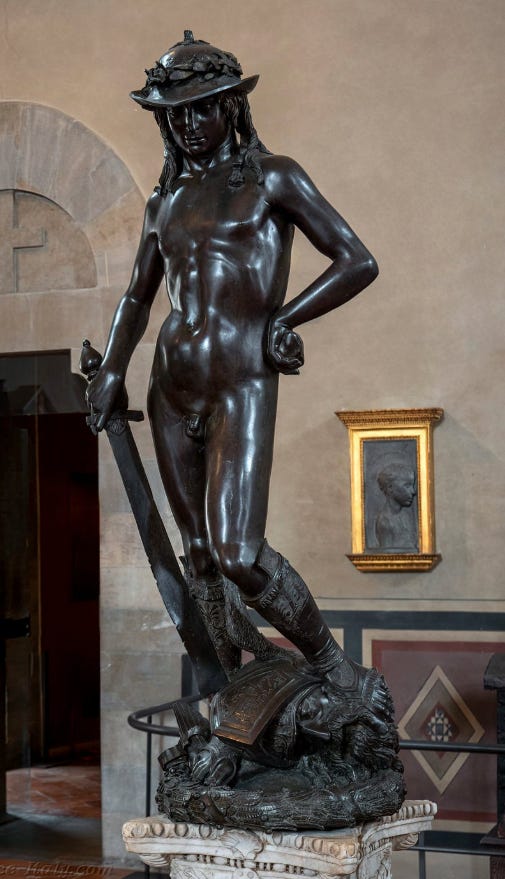
This is, of course, not only a famous statue today, it had become a veritable sensation pretty well immediately after its creation, rapidly establishing itself as an iconic Quattrocento masterpiece that significantly influenced some of the most famous artists in the Renaissance. No controversy there.
Rather more ambiguous, however, is what it actually represents.
If you open up any book on Donatello’s David, you’ll quickly learn that, like many of Donatello’s works, it’s saturated with homoerotic imagery – from the boy’s androgynous form to his ostentatiously firm, round buttocks to – most conspicuously of all – the feathers of Goliath’s helmet that provocatively stroke his inner right thigh.
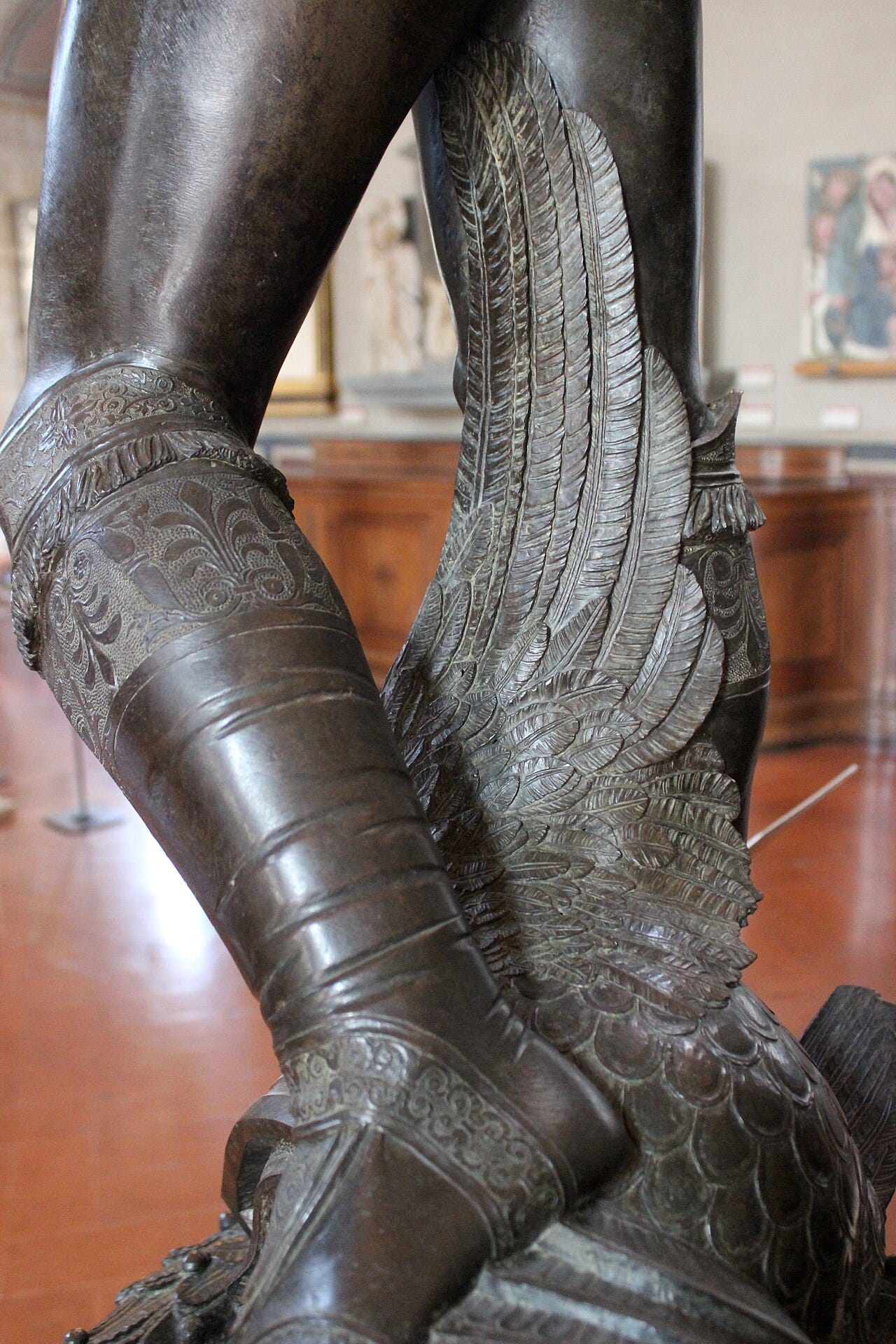
Indeed, I’d read this sort of thing so often and so consistently that the first word that would have sprung to mind had you asked me, a few months ago, to describe Donatello’s David, would most certainly have been “homoerotic”.
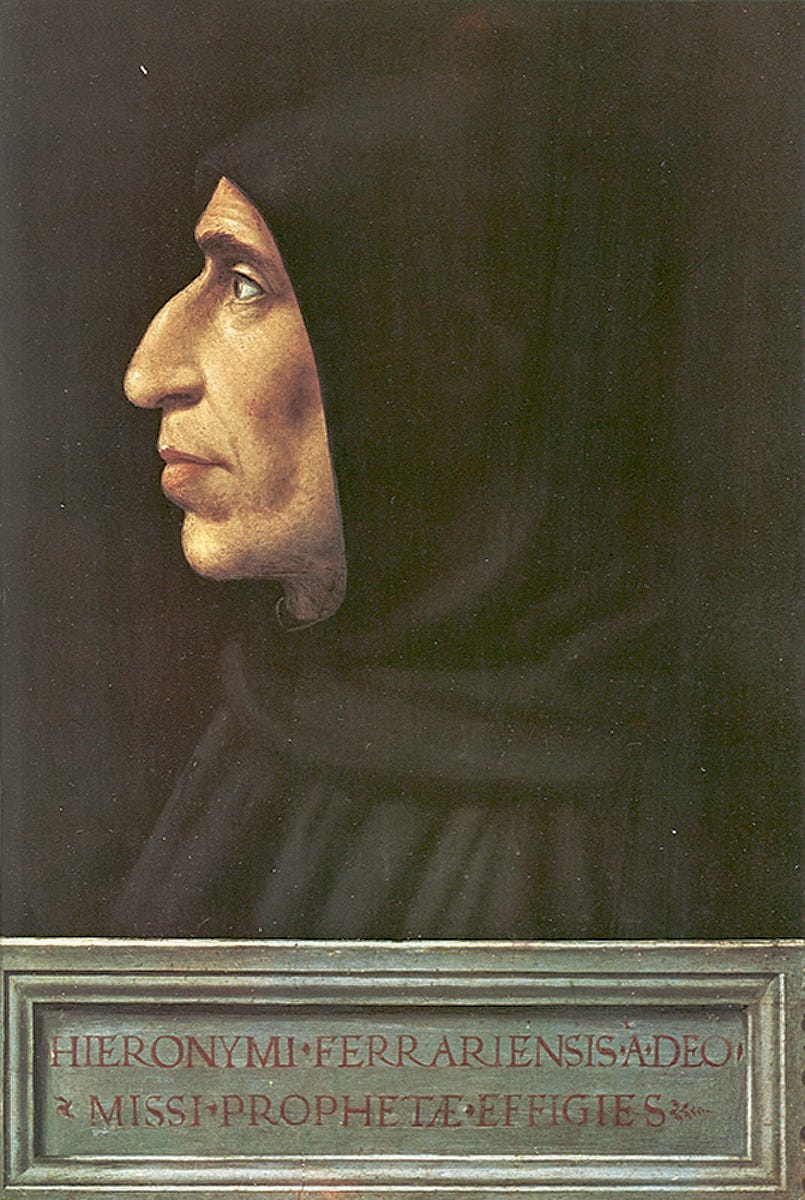
And then I read Jill Burke’s The Italian Renaissance Nude, where she calmly pointed out that the firebrand Florentine preacher Girolamo Savonarola had triumphantly placed Donatello’s David in the Piazza della Signoria, directly in front of the short-lived revolutionary government that he was strongly associated with.
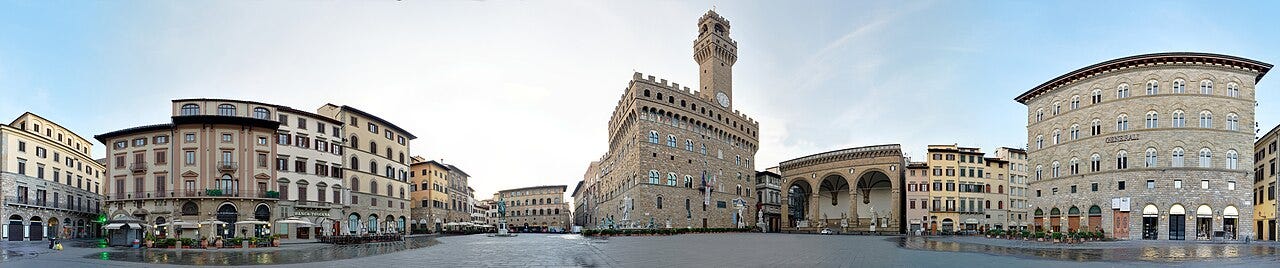
This was profoundly puzzling. How on earth was it possible that Savonarola – the famously incendiary friar who initiated the famous “Bonfire of the Vanities” in the same Piazza, a figure who consistently represented himself as having been sent by God to cleanse Florence of its perniciously immoral tendencies, most definitely including male homosexual activity1 – would have opted to prominently display such an avowedly homoerotic statue in the city’s most famous public square?
Well, it wasn’t.
The only possible explanation is that, for Savonarola and his late 15th-century Florentine contemporaries, Donatello’s David was not considered “homoerotic” in the slightest.
Now understand that I hardly present myself as an expert on homoeroticism, the sexual proclivities of Donatello, the pederastic implications of eagle feathers, or any of that. Nor am I triumphantly announcing some emphatic counter-claim to the current scholarly consensus, boldly averring that Donatello’s David is, in fact, not the slightest bit homoerotic at all.
I’d just like to know why none of the many detailed analyses of Donatello’s David I’ve read over the years ever bothered to mention that, despite our present-day conviction that this statute represents the acme of homoerotic desire, the most virulently polemical anti-homosexual figure in Florentine history obviously thought about it quite differently.
Isn’t it the business of history to put ourselves into the hearts or minds of those being investigated?
Howard Burton
Below you can watch Bodily Insights, my recent conversation with Jill Burke, Professor of Renaissance Visual and Material Culture at the University of Edinburgh, on our Exploring Art History YouTube channel. Jill discusses her extensive research on the development of the nude in the Italian Renaissance from both an art-historical and a socio-cultural perspective.
Find out about how many artists of the time found men more beautiful and proportional to model for them than women and how that affected the art we admire today. The conversation also examines changing beauty standards for women during the Renaissance related to the newly fashionable statues from Antiquity. This video podcast is illustrated with many images to highlight the wide range of artworks under discussion.
**This illustrated video podcast is also available on our Spotify channel HERE, while the audio version is available on the usual audio channels.
Known euphemistically at the time as “the Florentine vice”, as it happens.