

On Learning
Truly, madly, deeply

It’s hard to think of a word which has quietly done more damage to our true understanding of the learning process than “autodidact”. With its coldly logical connotations of “self-teaching”, it neatly splits our conception of the educational experience into two facile non-overlapping options: being taught “properly” – with knowledge presumably being smoothly poured into our heads by the wise – or somehow scrambling to do everything ourselves.
How such an obviously incorrect portrayal of human understanding could still be so much part and parcel of our contemporary worldview speaks volumes about our collective confusion about the nature of personal development (not to mention our perverse willingness to listen to “educational theorists” spouting sanctimonious gobbledygook).
Because the truth, of course, is that there are not “two ways” to learn something, but only one: grappling hard with a concept until we feel confident that we have gained some genuine level of comprehension of what the hell is really going on. And the role of “the educator” is not to mysteriously “provide us” with this profound internal awareness – that is impossible – but simply to point the way to trigger our individual motivation and curiosity so that we can better slog through the often difficult process of doing it ourselves.1
You’d think, since this is a phenomenon that is both entirely subject-independent and age-independent, we’d all be so intimately familiar with it that there’d be no point in even mentioning it, let alone writing about it, but somehow that’s not the case.

Allow me give you a few revealing examples from my own experiences.
Years ago, when I was doing my masters degree in theoretical physics, I took a course in differential geometry that made me abruptly realize that everything I thought I knew about the subject was only a pale shadow of the proper way to look at a compellingly beautiful world of much deeper, interrelated concepts. But at the time, all I had was a glimpse of the promised land: I didn’t work sufficiently hard at rigorously understanding what I had been presented with, and I never got to the point where I could actually calculate anything. Come exam time, I failed the course miserably – I got my degree, though, because it so happened that the administrative requirements associated with this particular program allowed candidates to fail one course.
So the first thing I did when I later started my doctorate was to take a few months and go through that mysteriously captivating material line by line, forcing myself to actually make some sense of it. And from there I lurched enthusiastically into many other aspects of this eminently captivating world.
Then, a few years later, after somehow finding myself in the position of building and running a research institute, I decided to also construct an ambitious outreach program to spread the word about the joy of discovery to the general public, and promptly found myself getting a taste of how most “lay people” viewed the process of scientific understanding.
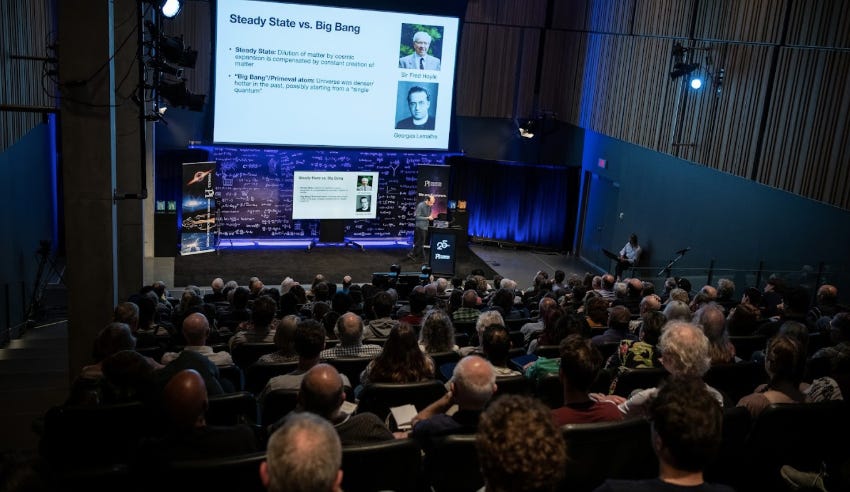
Immediately after almost every public event, people would come up to me and say, “Thanks so much for doing this. I always hated physics at school, but now I really regret having dropped it. It’s fascinating.”2 At the time I just smiled and moved on, but what I invariably found myself thinking was, So? So just learn it now if you want.
Because the implication of such a sentiment was always: Well, I missed the opportunity to take this or that course, so now I’ll never be in a position to learn it properly like all you guys with your fancy degrees.
Sheer nonsense.
In terms of knowledge, the only thing a degree really represents is time. If you spend four years, say, single-mindedly dedicating yourself to understanding something, then you’re naturally going to make real progress towards your goal. And if you spend half that time goofing off, or trying to convince your peers of your brilliance, or playing tennis (unless your degree is in tennis, of course), then you’ll naturally know much, much less than you otherwise could. In both cases you’ll likely have a degree (well, unless you really goof off). So what?
Anyone who’s ever unsuccessfully tried to learn another language knows this intimately. It’s not about some piece of paper you may or may not have “earned” through a course, the only thing that matters is whether or not you have somehow acquired the requisite knowledge: your confidence level (or lack thereof) when expressing yourself in another tongue, your ability to comprehend what native speakers are saying, your facility at reading a foreign novel or newspaper without a dictionary.
The confusion, I think – the widespread contemporary value associated with a degree per se – is doubtless related to the fact that, in the vast majority of cases, a university degree (bachelors, masters, or increasingly doctorate) is simply a means to end: a necessary stepping stone to a solid career, proof of one’s ability to successfully jump through various hoops, or think independently, or handle the pressure.
As publications like The Economist are forever pointing out, and millions of anxious parents the world over are acutely aware, there is a resoundingly strong correlation between the possession of university degrees and one’s future salary, with those graduating from the most prestigious institutions most likely to earn the highest salaries of all.
Formal education, in these terms, is thus rightly regarded as an “investment”. But not an investment in learning or understanding – expressions which with it is so often, and so duplicitously, conflated – but simply an investment in the straightforward economic sense of the word.
Whether or not, on the whole, this is a good thing or a bad thing for society is well beyond the scope of this article:3 my point is simply that, for all its manifest utility as an objective socioeconomic asset, a university degree has very little, properly, to do with actual knowledge.
Meanwhile, if you want to actually learn something, you just need three things: strong motivation, access to the requisite content, and a few good guides to point you in the right direction.
It’s also helpful, of course, to have a fully working brain. And while many of us older folks sometimes worry that we might not be quite as sharp as we used to be, this is more than compensated for (or so I keep telling myself), by being emphatically liberated from the tedious constraint of caring what anybody else thinks about us.
And most fortunately – as I’ve recently been recently going on about (see here and here, for example, among numerous other examples), modern technology now provides opportunities like never before for curious, motivated learners to easily, and rigorously, plunge into any topic imaginable from the comfort of their own living room.
In particular, a few years ago, I decided that it would be a good idea to make some films about Renaissance art. Here was a fascinating, beautiful, inherently visual topic perfectly suited for the new tools of digital media, for which almost no genuinely informative and stimulating non-written treatments existed, while the few existing documentary-style films were invariably superficial, formulaic (loaded with “talking heads” uttering the most anodyne possible things) and often flagrantly, depressingly, inaccurate.
Clearly, this was a wonderful opportunity to responsibly explore these historic artistic accomplishments using the standard modern digital media tools that everyone now has easy access to. Unfortunately, however, I knew very little about the subject.
Well, so what?
Even if you have the misfortune to find yourself (as I am) far removed from a particularly well-stocked library, there are two essential tools that any determined learner can use to significantly deepen his knowledge of virtually any subject: the Internet Archive and JSTOR. Both are completely free, accessible to anyone with an internet connection.4
A few years – and several films – later, I would hardly call myself an expert, but at least feel that I have a reasonably solid base upon which to continue my ongoing artistic filmic journey.
And along the way, I’ve naturally encountered a few wonderful guides to assist me, deeply knowledgeable and insightful people who’ve consistently inspired me to think much deeper about the subject at hand.
But when I say “encounter”, I should clarify, I don’t mean that I’ve actually met them in person. Sadly, I haven’t. But that hardly means that they haven’t had a tremendous impact on me. Which means that they might well end up having just as large an impact on you, too, if you’re interested.
Next week, I’d like to highlight one of my favourite art-historical guides of all: the incomparable John Shearman (1931–2003), former Charles Adams University Professor at Harvard University and one of the most influential and well-respected art historians of modern times.
But that’s not why I’m mentioning him. It’s because what he had to say is so damned fascinating.
Howard Burton
A brilliant summation of this obvious, yet mysteriously overlooked, point in the context of basic mathematics education was penned by the mathematician Paul Lockhart - see here for an illuminating taste.
This is a particularly common reaction that most people have when it comes to physics, which I’ve long surmised is because the vast majority of high school physics teachers are simply terrible. But that’s a topic for another day – or, better still, hopefully I’ll manage to suppress my urge to comment on it indefinitely.
Although it’s clearly awfully hard to justify morally when twinned with precipitously high tuition fees at top institutions that naturally exclude the vast majority of the populace from the prospect of achieving some measure of economic parity.
The Internet Archive is one of the true jewels of our time – the sort of thing that we were hoping would happen (but rarely was) back when the digital age started in earnest in the late 1990s. But for all that it has certainly had its share of difficulties – last year, I wrote this piece about it when it was in the midst of its ongoing lawsuit with a group of publishers, which it eventually lost. As for JSTOR, its benefits extend well beyond the many academic institutions who subscribe to it: they also freely give access to 100 read-only articles per month to independent researchers, a number I have never come close to approaching even during my most intense periods of study.
Imagine what it must have felt like for a scholar around 1500, when the printing press was still a new wonder, enabling knowledge to be shared faster and more cheaply.
Then you walk out of a time machine and take out your laptop. Miraculously, there is also WIFI.
The Renaissance Man is already puzzled by the shiny object and the moving images on its screen. You tell him, "Ask me to find any book you want."
Using Archive and JSTOR, as well as national libraries' websites, you find him entire books within minutes. High-definition scans of manuscripts, enluminated books, and anything he dreams of. Renaissance Man is so overwhelmed that he does not know what to say.
That's how lucky we are.