

On The Ground
The good, the bad, and the ugly

The last few weekly posts have been about the unique joys of experiencing Italian Renaissance art in the flesh: how, somewhat inexplicably, none of the research done ahead of time can adequately prepare you for the overwhelming experience of standing directly in front of an artistic masterpiece.
There’s much more to say here, of course - there is always much more to say here - but this week’s post is about a rather different sort of emotional response: the joys and frustrations encountered in order to personally encounter those masterpieces in the first place.
I should, of course, begin with the obvious: Italy is positively saturated with tourists, particularly in the summer, which clearly puts a tremendous strain on everything and everyone, a state of affairs considerably exacerbated by the seemingly never-ending, mind-shattering heat that we are all subjected to these days. Long, long gone is the joyful prospect of rambling haphazardly through unfamiliar streets in search of serendipitous encounters: every visit, seemingly every hour, must now be planned out in detail so as to avoid the terrifying scenario of finding yourself stranded in some sun-blasted piazza, unable to sufficiently cool down your overheated brain to find a way to navigate back to safety.
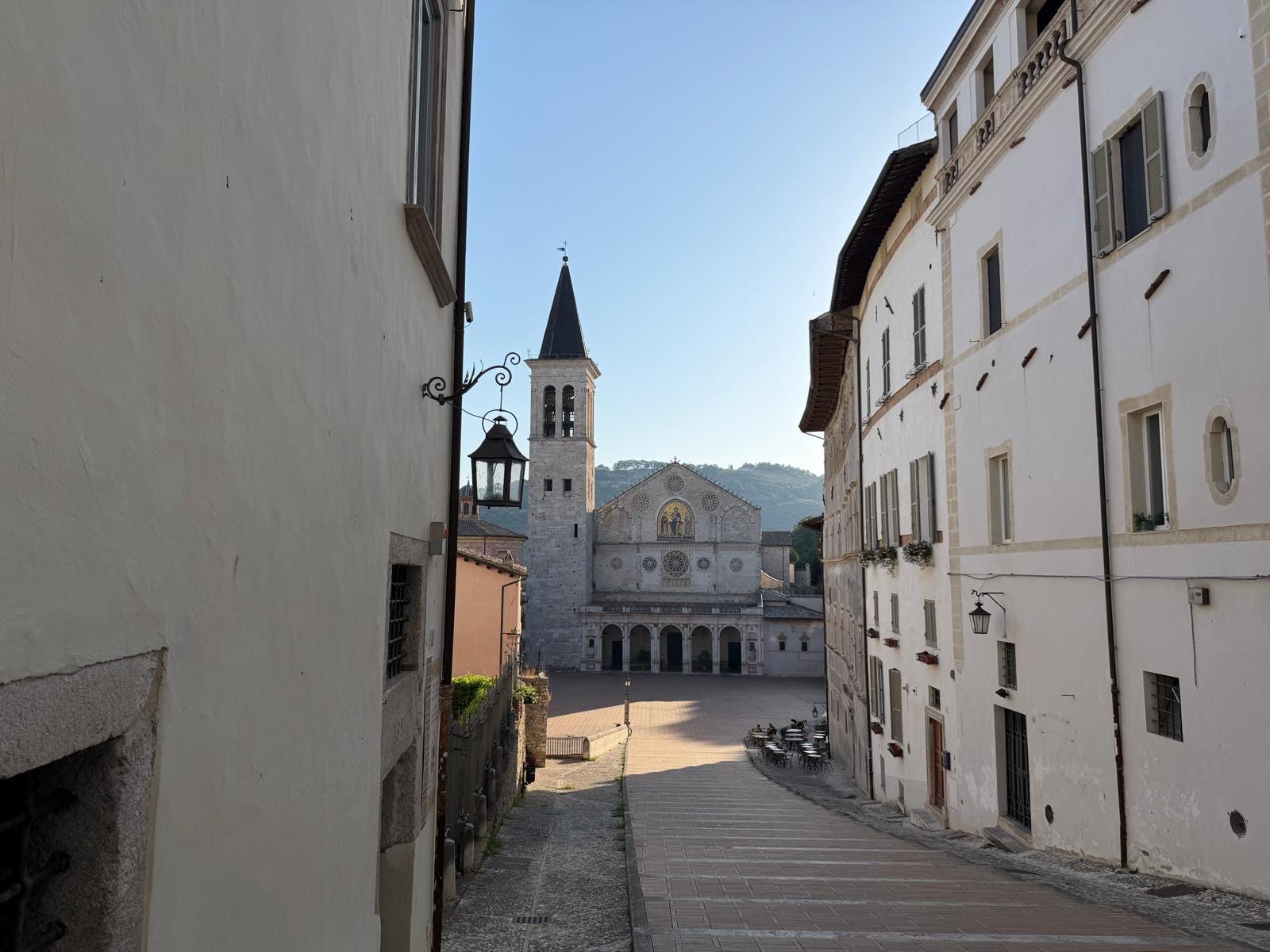
We still meander, Irena and I, but almost all of our exploratory wanderings are now limited to the hours of 6-8 am, when the heat is still manageable and the streets are often deserted. We’ve always liked to get up early and watch towns slowly come to life, but that’s pretty well the full extent of the exploratory options left to us these days.
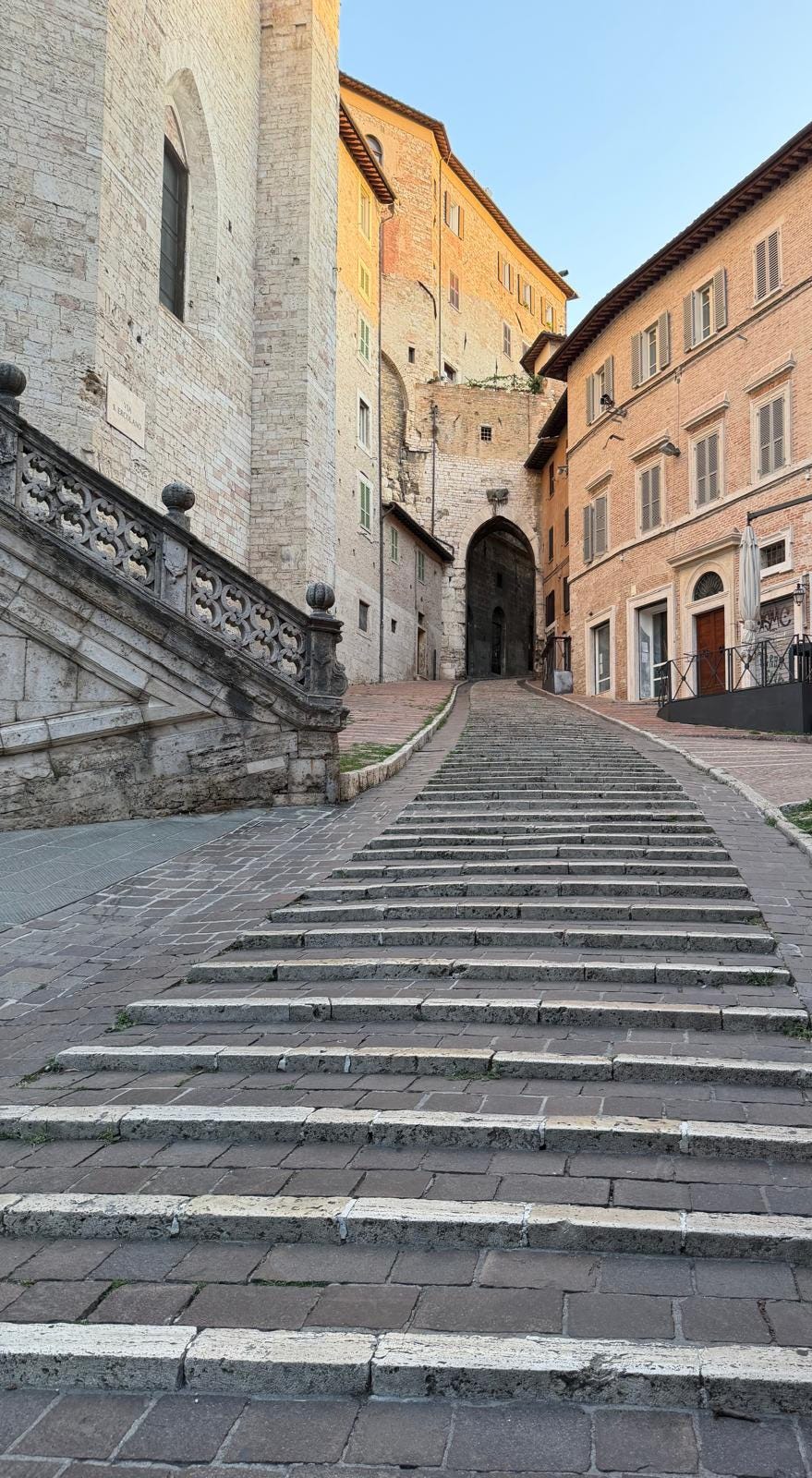
Evening temperatures don’t typically fall below 30 until 8pm or so (no, all you Americans out there, I won’t “translate that into Fahrenheit” for you: it’s high time you learned the way the rest of planet earth measures temperature, particularly since your rampagingly selfish actions are playing such a non-trivial role in dangerously increasing it), and the prospect of wading through loud, steaming, mobs of foreigners, aggressively chomping on their pizzas in garbage-strewn cobblestone streets is not terribly enticing. To put it rather mildly.
I should add, for completeness, that the vast majority of these foreigners are actually Italian. Of course, there are countless Germans, British, Americans and even a few French throughout - not to mention, of course, the omnipresent Dutch (are there any Dutch left in The Netherlands, I wonder? There is not one place I’ve been to in France or Italy that is not positively saturated with Dutch license plates), but as Rai TV is consistently informing us, some 27 million Italians are currently on holidays these days. We non-Italians tend to forget about this, because we unthinkingly conclude that if someone is prattling away effortlessly in Italian, they are somehow “local”. But come August, more often than not, that’s simply not the case.
Which is all to say that you’d have to be a pretty unempathetic soul not to appreciate how enormously taxing all of this has to be on the people who actually live in a “tourist destination” - which, when it comes to Italy, is pretty well everywhere (amusingly, the institutional structures that are most focused on assessing the extent to which a place is, or is not, “loaded with tourists” are themselves tourist-oriented: every tourist guide I’ve ever seen enthusiastically directs its readers to “less touristy” destinations that are both “genuine” and “real finds”). And somehow, inexplicably, most Italians manage to survive this unrelenting foreign onslaught with both their sanity and sense of humour fully intact. Quite frankly, I don’t know how they do it.
So that’s the vital starting point for what follows: it’s not much of an exaggeration to say that the entire country is under siege, tourist-wise, and it’s far from clear how it should be dealt with. Some, like my fellow Substack art-focused writer Michele Dantini (see here), believe that the time has come for drastic action to stop “overtourism”, firmly advocating the universal implementation of a “chilometro zero” approach to travelling. Personally, I’m unconvinced, both theoretically and practically. But I sure understand why he’s proposing it. And I’m deeply sympathetic to his all too evident frustration.
So it’s complicated. Aside altogether from the obvious economic interests at play for a country whose GDP has such a large tourist-related component, there are broader cultural concerns too. After all, the primary reason so many people flock to Italy’s shores is because they feel motivated to personally interact with vital aspects of its incomparable centuries-long parade of cultural magnificence. And however tedious some of these people might seem to me and you, as they aimlessly drift through museums glued to their phones before occasionally popping up to block our views of the surrounding masterpieces with a prolonged selfie, it’s very much worth remembering that at least they are actually in museums.
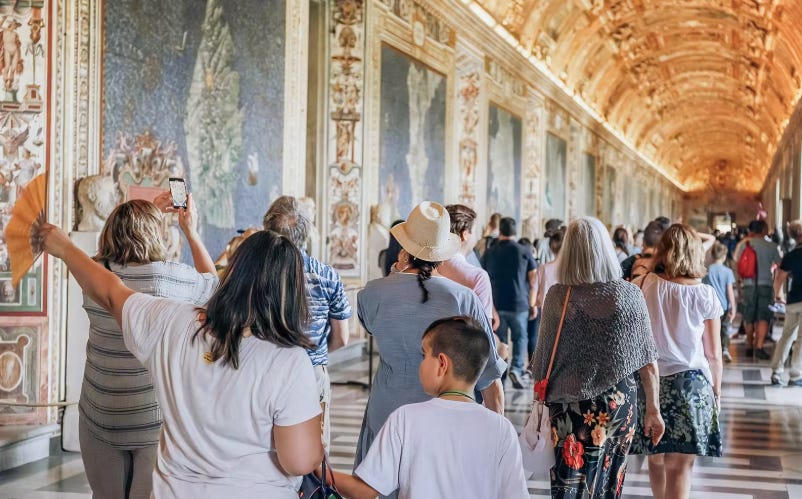
These are, in other words, the good tourists. They are motivated, however superficially and perfunctorily, to at least slightly improve their lives through encountering some of history’s most celebrated artistic creations. They are not simply mindlessly fornicating away their time in Ibiza. Put another way: if we alienate all of these people, we are all surely, irrevocably, lost.
And a significant number of Italian cultural institutions are, it must be admitted, doing precisely that.
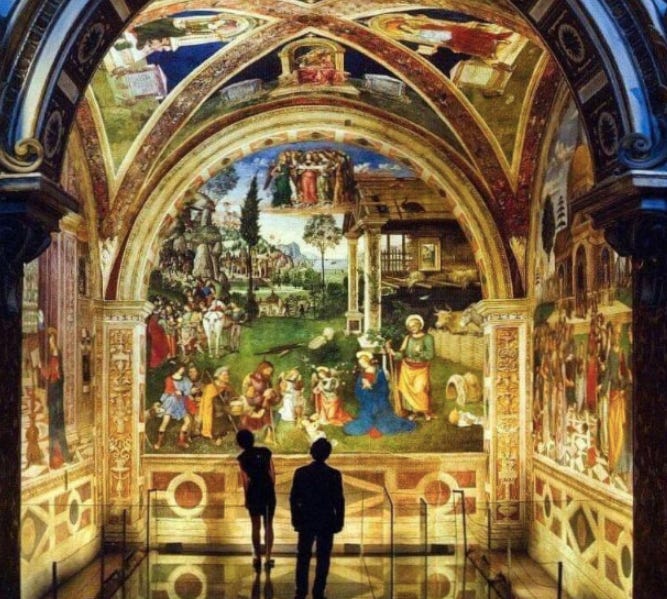
A few days ago, we were in Spello, whose primary cultural accomplishment, the dominant reference point that makes it a destination for any artistically-inclined tourist, is Pinturicchio’s frescoes in the Baglioni Chapel of the Collegiate church of Santa Maria Maggiore.
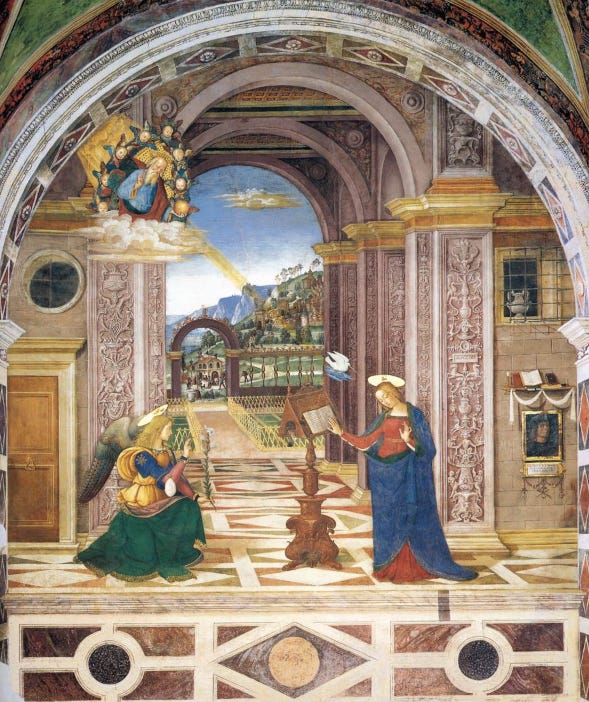
Created in 1501 by Pinturicchio and his workshop towards the apex of his fame (in between his frescoes in the papal apartments for Alexander VI and his work in Siena on the Piccolomini library and much more), these are truly marvellous works of art that merit a close, prolonged look. But that’s precisely what the folks in charge of admissions to Santa Maria Maggiore are keen to avoid. Visitors are charged 3 euros each to the otherwise decidedly unimpressive church (there are two other frescoes inside that, quite frankly, I could have painted, that are hugely implausibly claimed to have been done by Perugino) before being told that they are only permitted to enter the chapel for ten minutes. Even worse still, photography is strictly, vehemently, prohibited (I tested this by unobtrusively taking a quick video on the other side of the church and immediately found myself confronted by a finger-wagging apparatchik who had glimpsed my transgression through one of the many surrounding video cameras lining the walls).
Why?
Well, there is no reason, of course. Other than, perhaps, to ensure that the church can somehow extract yet further revenues from art-inclined people through “licensing” their images via rapacious IP extortionists like Getty and Alamy (a disturbingly widespread practice throughout the Italian peninsula, incorporating many of its most renowned cultural institutions, such as the Uffizi Gallery - see this related Substack piece from last August, if you dare). It is, in short, simply disgraceful. Pinturicchio deserves far better. And so, of course, do you.
In our relatively short time here, we’ve witnessed several similarly infuriating instances throughout Tuscany and Umbria, occasions when tourists are clearly viewed as nothing more than local revenue-generating devices, to be duly ripped off as quickly, and dismissively, as humanly possible.
But that, importantly, is hardly the end of the story. Not by a long shot.
The other day, for example, we visited Perugia’s Galleria Nazionale dell’Umbria. This is simply a fantastic museum. Not only is there vastly more wonderful art within its walls than I had naively appreciated (and I really mean vastly - this is what happens when you have centuries of the highest level of artistic production coupled with innovative, motivated curators), but I frankly can’t remember ever having had a better museum experience anywhere.
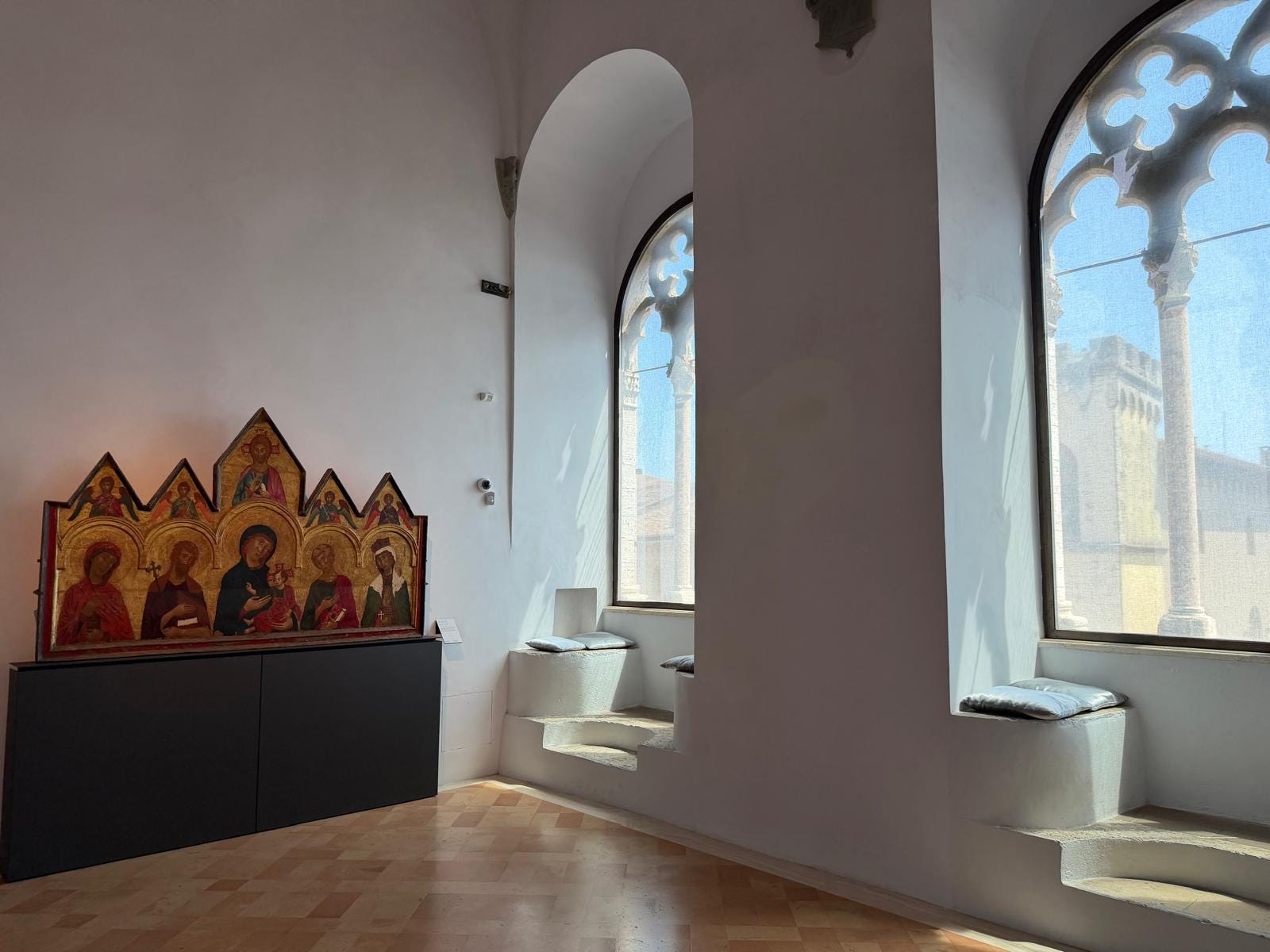
From the judiciously spaced positioning of the artworks, to the carefully considered lighting, to the thoughtful written descriptions, to the compelling multi-media displays, to the frequent opportunities to comfortably sit down and quietly engage with the art, to the wonderfully, uniformly appropriate climate controls (Yes! Italy is indeed capable of doing air conditioning properly!), I can’t recommend this museum enough. Every museum director should check this place out: it is, quite simply, quietly setting the standard of what a top-quality gallery should be.
Well, you might say, it’s a question of scale. The Perugia museum is a national one, while the Spello collegiata that so infuriated you is obviously tiny and struggling. Have a little understanding for smaller places.
But that argument simply doesn’t hold water. Aside from the obvious point that many larger museums are incorrigibly lazy and similarly exploitative, only maintaining their dominance through the inestimable value of their many world-class holdings (yes, I’m most definitely looking at you, Uffizi Gallery), there are also many smaller museums we’ve recently encountered that are warm, intimate, and - quite simply - lovely, such as Arezzo’s Museo Nazionale d’Arte Medievale e Moderna, Sansepolcro’s Museo Civico and Cortona’s Museo Diocesano.
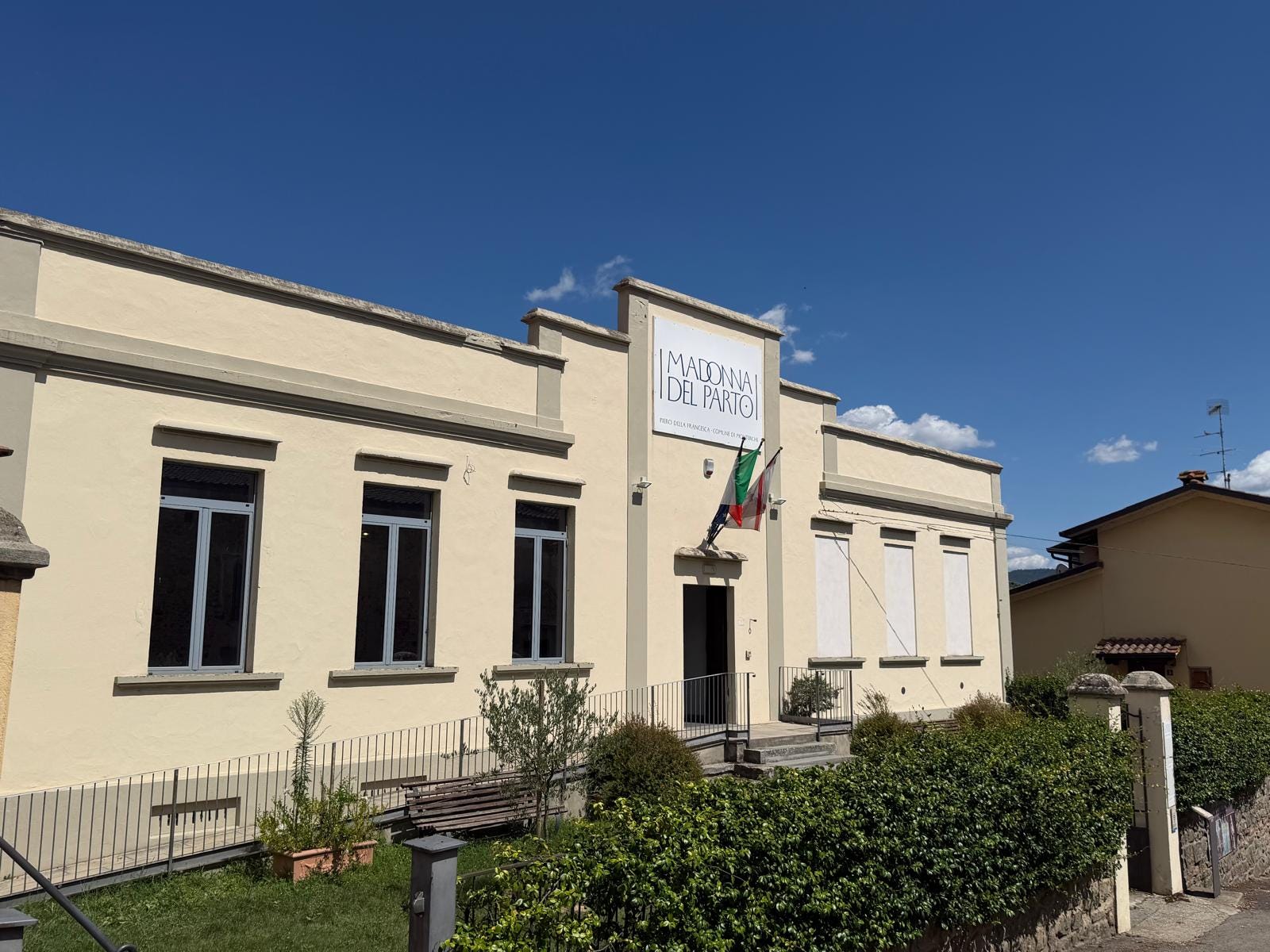
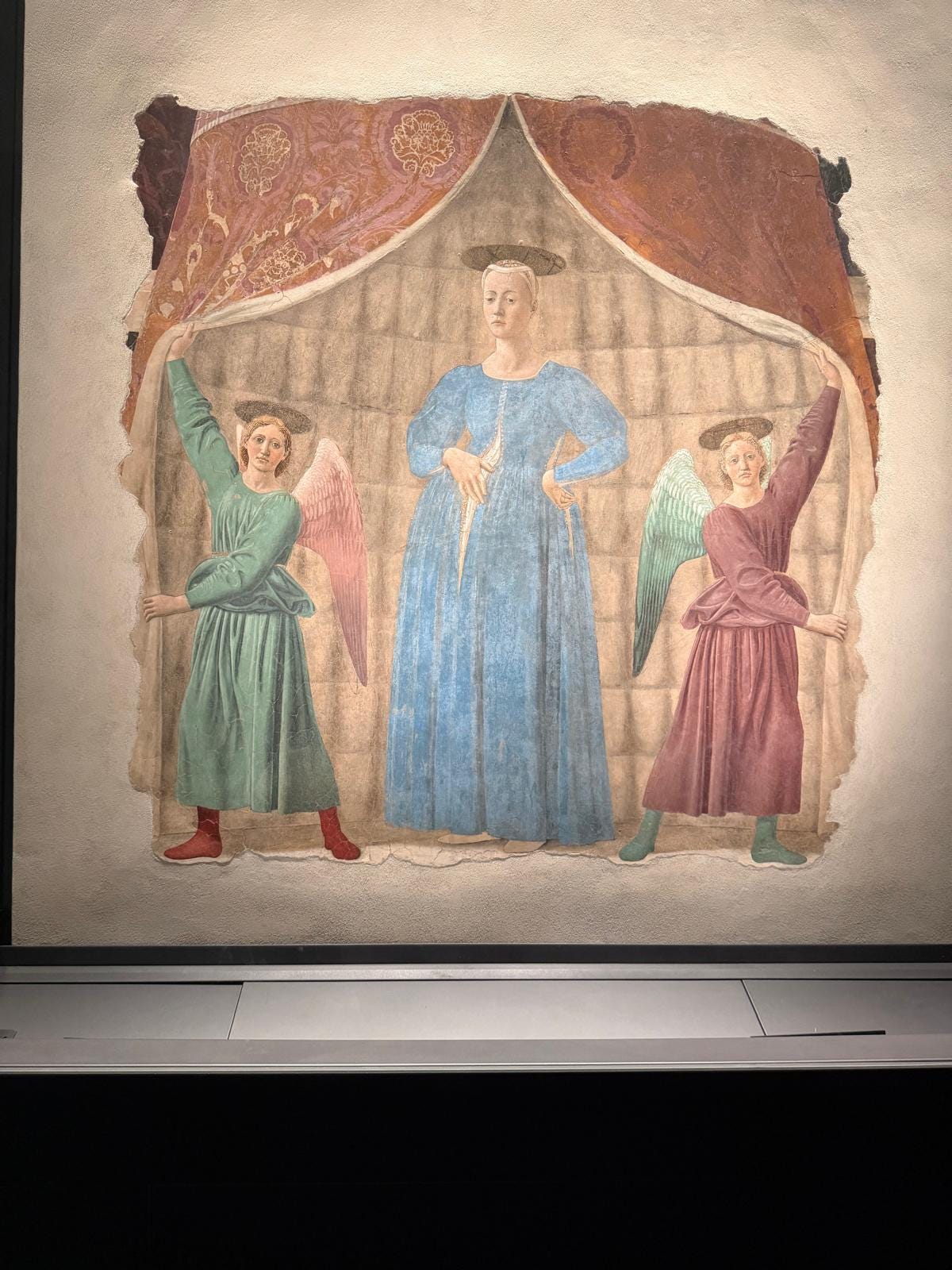
One of the most illuminating visits we’ve had so far has been to the tiny town of Monterchi to visit the Musei Civici Madonna del Parto, a former schoolhouse which contains precisely one work: Piero della Francesca’s enchanting, restored fresco of the Madonna del Parto, once housed in a nearby church. I was, I must confess, at first quite sceptical at the prospect of an entire museum dedicated to a single work, but it proved to be exceptionally memorable: a unique opportunity to quietly commune with one of the most moving works of art one could ever encounter.
And then there was the Museo della Basilica di Santa Maria delle Grazie in San Giovanni Valdarno: a quaint, out of the way place that nonetheless contains a wonderful Fra Angelico Annunciation and a few compelling works by Lo Scheggia and others. Once more we were there right when it opened, whereupon the woman at the desk shamefacedly informed us that she didn’t know how to turn on the lights (it was her first day, apparently). So we wandered around, alone and in the dark, for 45 minutes or so, pressing our noses up to the surrounding artwork. Eventually, of course, she figured it out (I believe she actually called in someone else who knew where the right switches were), so we spent half of our time in the dark and another half in the light. When we finally left, she profusely apologized for the inconvenience, but she needn’t have bothered. We had a wonderful time. When the lights finally came on, we got to test our dusky predictions; in fact, we probably ended up seeing much more this way than had everything been working perfectly when we arrived.
Both the Musei Civici Madonna del Parto and the Museo della Basilica di Santa Maria delle Grazie cost roughly twice as much as Spello’s collegiata, but we didn’t feel ripped off in the slightest. It’s not about the money. It’s about the experience.
Howard Burton
Recent essays that might be of interest as well:
A Question of Ownership

It’s always difficult to predict when dramatic, wholesale changes in public attitudes will occur. Had you asked me back in 2009, when the beautifully-constructed Acropolis Museum in Athens just opened, what would be more likely to happen: the repatriation of Lord Elgin’s stolen Parthenon frieze to its rightful home or the widespread legalization of marijuana throughout the United States, I would have naturally assumed that you were joking.
The Art of Looking Closely

When it comes to appreciating paintings, there’s nothing more impactful than being in close proximity to the actual work, preferably in a setting where you can take your time to actually see what’s in front of you, as opposed to quickly scanning the picture or being confronted by others standing backwards in front of the art. By taking, say, 10 minutes of quietly sitting or standing in front of a painting, you can feel how your eyes and your brain are starting to focus to be able to discover more and more details that you may not have noticed at first glance.
In Situ And In Awe

As you’ve surely noticed, Irena has recently taken over our Substack helm, penetratingly describing – among other things – how the opportunity to stand directly in front of a masterpiece comprehensively transforms one’s artistic experience.
A Tale of Two Cities

The fact that last month’s brazen jewel heist at the Louvre quickly became the greatest international feel-good news story is doubtless a sad commentary on our troubled times.
Great read! When I was an university student, I lived in a fairly touristic city. I remember one time I got stuck behind a group of tourists and their guide. The street was too narrow for me to walk past them…and I was running late to one of my lectures! I’d say locals are used to tourists crowding their cities and for the most part, it is not a problem. However there are some instances when it could be a bit annoying (I’m leaving out of the discussion the bigger problems related to mass tourism, like rent prices for locals). I am not blaming tourists themselves, I understand that people want to enjoy their summer holidays in beautiful places like Italy. Though I do think that this is something that should be regulated by Italian authorities. Mass tourism is not sustainable for locals and not enjoyable for tourists. I also hate to see Italian masterpieces “cheapened” in their value and at same time, used to rip off foreigners. I am happy you got to have some pleasant experiences in smaller Italian museums!
Great post!