

Only Connect
The power of art

For all its wondrous ability to seamlessly combine beauty and curiosity, perhaps the thing I love most about art history is its capacity to emotionally connect us to others.
Not all fields of study do this. Cosmology, for example, fuses beauty and curiosity like nothing else, but is flagrantly independent from human sentiment – indeed, from humans altogether. Aside from the thrill of discovery, the only emotion prompted by the fact that we now understand key aspects of the very early universe is a feeling of collective pride that our benighted tribal species can occasionally get its act together to unravel profound mysteries well beyond our petty, parochial horizons.
Such is the timeless appeal of the natural sciences – which, for many sensitive souls, must surely be greater than ever these days, when so much of humanity’s markedly less salubrious tendencies are on such vivid display from every conceivable direction.
But the thing about being human is that, like it or not, we need other humans. We need to connect. We need to matter. We need to love. For all their crystalline magnificence, equations alone can not fully give us sustenance. It’s why Einstein played the violin and von Neumann threw wild parties.1
Enter – for me, at least – art history, a discipline that offers more intriguing opportunities to explore our beguiling web of human connections than anything I know:
How did an artwork get commissioned in the first place? What was its envisioned functionality, exactly, and what additional potentialities were hoped for? Why was that particular artist chosen?
Then, of course, there’s the question of what might have been going on in the mind of the artist. What significance, if any, did this detail have, as opposed to that one? Which viewers were believed to have been particularly sensitive to which specific literary, cultural and iconographical features, and why? To what extent was there a tension between a personal desire to innovate and a requirement to create the work in a particular, pre-ordained, way? How difficult was it to produce a single, coherent work from a diverse, multi-faceted workshop? In what way was the artist influenced, deliberately or unconsciously, by more successful (or less successful) contemporaries?
While some works of art were specifically designed to satisfy the personal needs of patrons and their immediate family, others – like altarpieces – were explicitly created for a vastly broader audience, sometimes for generations. What does their reception – both positive and negative – say about the values, beliefs, desires and aesthetic orientation of those societies, which are themselves in a seemingly constant state of flux?
Duccio’s phenomenal double-sided Maestà, recognized today as one of the greatest paintings in the history of art, dominated Siena’s cathedral from its commanding perch on the high altar for almost two centuries. Then it was summarily shuffled off to hang in a side chapel, where it remained for another 270 years or so, after which it was taken down and sawn into various pieces, some of which were sold off.
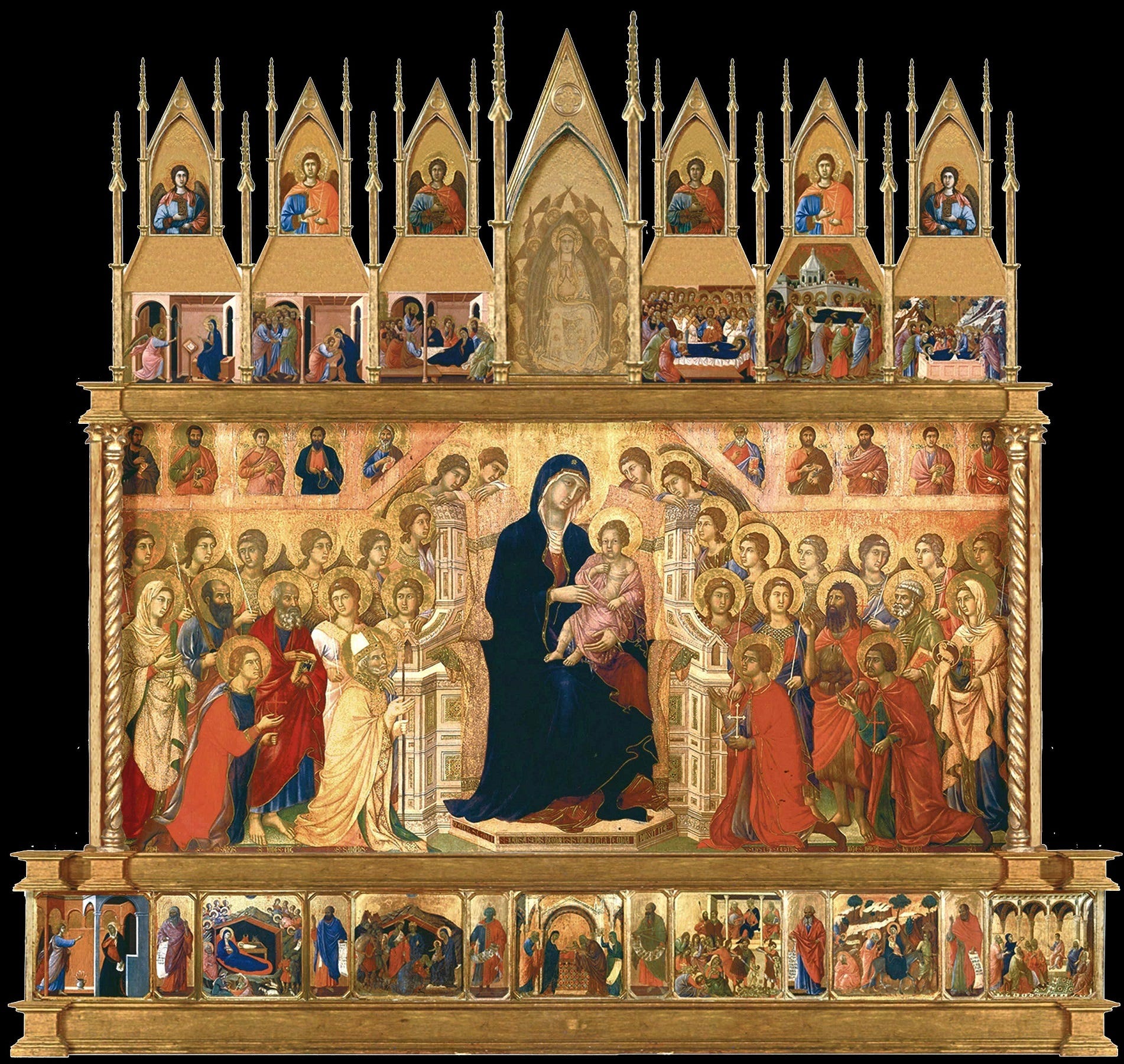
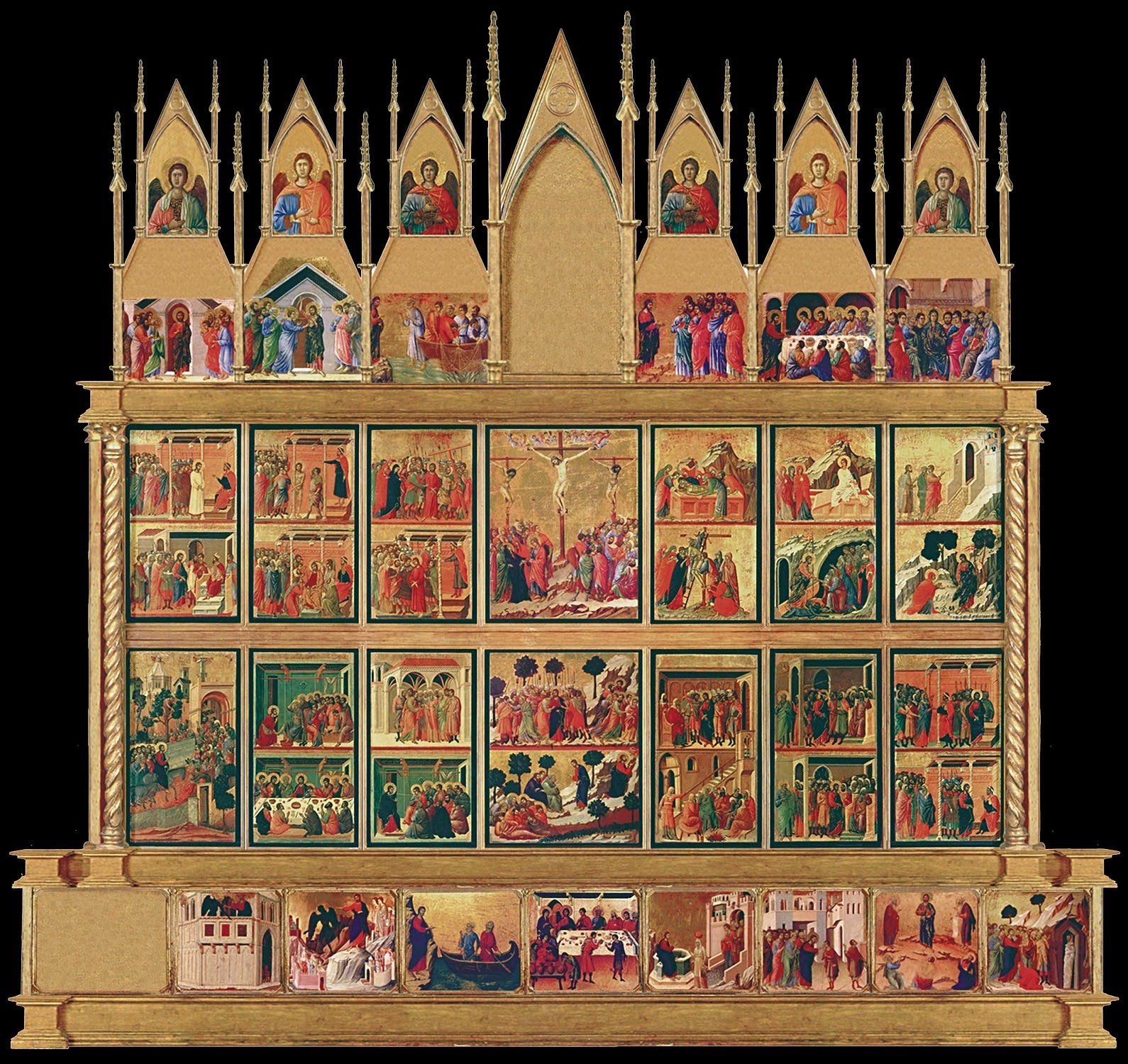
Why? What had changed? What were they thinking?
In 1311, everyone was convinced that Duccio’s Maestà was an unparalleled masterpiece. In 2026, everyone believes that too. But in the 1770s, those running Siena’s cathedral evidently regarded it as little more than an oversized, outdated asset whose parcelling off could significantly help with their balance sheets. How on earth is such an earth-shaking change in perspective even possible?
I have no idea. But it happens. Often.
Botticelli was an enormously popular artist in the second half of the 15th century. Today he is considerably more popular still. But for the better part of 350 years he was almost completely ignored by both art historians and the general public. Why?
And why is it that Raphael, who died only a decade after Botticelli, has consistently remained an exemplar of artistic excellence – indeed, for long periods of time, the exemplar – all the way through the intervening centuries? What does that say about their art? What does that say about us?
Once again, I don’t know.
All I’m certain of is that through studying the emotional impact of specific works of art over the centuries, we can form deep personal connections with those who lived in very different times and places.
And sometimes, times and places much closer to home.
These days, as part of my ongoing efforts to focus on the manifold artistic splendours of Siena, I’m finding it hard to extricate myself from the grips of its magnificent cathedral, which contains far more artistic masterpieces, inside and out, than any one building has a right to.2
In a recent post, Slandered By History, I mentioned the remarkable Piccolomini Library that’s annexed to the duomo and entered through a door midway up the nave on the left hand side. Commissioned by Francesco Todeschini-Pioccolomi, the nephew of Pope Pius II (who himself later ascended, albeit briefly, to the papacy as Pius III), the entire beautiful structure is an explicit tribute to his uncle, with a spectacular series of 10 frescoes by Pinturricchio lining the walls depicting ten celebrated scenes from the life of his uncle.
I was familiar with basic aspects of the Piccolomini Library through researching my 2024 documentary biography of Raphael3 because it’s long been established that the young Raphael was intimately involved in the planning, if not the execution, of at least several of these beautiful frescoes – a remarkable feat in its own right given both his age (he was only 19) and the fact that Pinturrichio, who had painted the Vatican apartments of Pope Alexander VI several years earlier, was one of the most famous fresco artists around.
But I wanted to know more. So I turned to various sources, eventually stumbling upon the 1993 PhD thesis of one Gyde Vanier Gilbert Shepherd: A Monument to Pope Pius II: Pintorichio and Raphael in the Piccolomini Library in Siena, 1494–1508.4
It’s a most impressive piece of scholarship that particularly captivated me with its suggestion of a conceptual and structural link between the vault of the Piccolomini Library and the two most celebrated ceilings in the history of art: Raphael’s Stanza della Segnatura and Michelangelo’s Sistine Chapel – an intriguingly provocative claim that I’ll explore in next week’s post (here is the aforementioned essay: Unlocking The Vault).
But, in the spirit of today’s topic of connectedness, my focus now is on something much more direct, much more personal. When I opened the thesis and flipped through the opening preface, I’d expected to find the usual story of an accomplished twenty-something scholar excitedly embarking on a professional career.
Instead I found quite a different tale. Shepherd had indeed begun his doctoral research in his late twenties. But that was in the mid-1960s. His grateful remarks towards those who helped him with his original Sienese investigations paint a lustrous picture of a golden age in modern art history – John Pope-Hennessey enthusiastically introducing him to the Petrucci Palace, James Ackerman “keeping his sight lines straight but open” and Redig de Campos arranging full access to the Vatican Library and Archive of the Opera del Duomo in Siena – as he and his fellow students Lodovico Borgo, Marcia Hall, Rab Hatfield and Andrée Hayum avidly plunged into the world of Italian Renaissance research.
Shepherd didn’t join his fellow students on their internationally recognized research trajectories, however, opting instead to leave his doctorate unfinished and take up a position as a curator and administrator at Canada’s National Gallery under the direction of Jean Sutherland Boggs – a job he glowingly referred to as “the career of a lifetime”.
And then, somehow, some 25 years later, he plunged back into the scholarly fray. Encouraged by his wife Rosemary and the formidable Harvard art historian John Shearman5 , Gyde re-enrolled at Harvard to finish what he had so impressively started, finally getting his doctorate four years later at the age of 57.
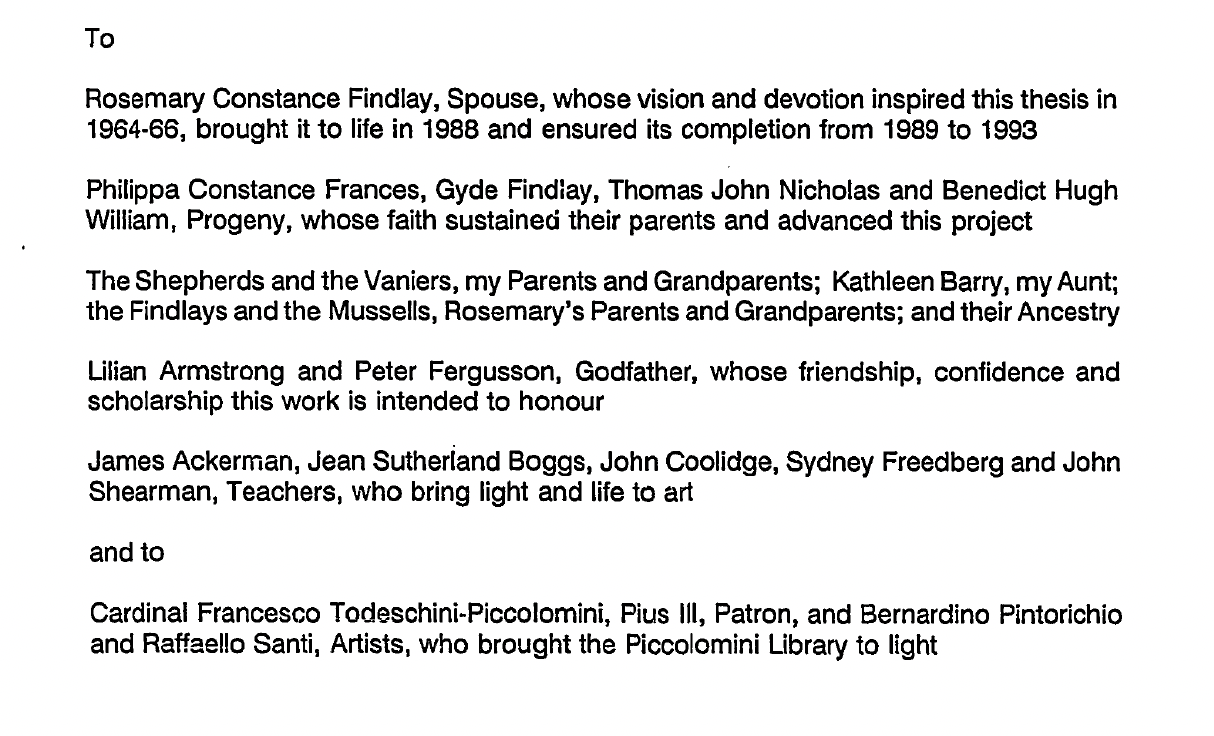
It could not have been easy. It was probably expensive. And there were surely times when his confidence wavered and he questioned what on earth he was doing. Starting afresh in your advanced years is not for the faint of heart. Take it from me.
But in the end, beauty and curiosity carried him through. The last line of his preface was a reaffirmation of a dictum he had first heard as a young student and now knew, through careful experience, to be true:
Art history should be analogous to the careful peeling-off of layers of an onion, gradually revealing to and from its centre, the multi-facetted complexity and richness of the work of art.
Gyde Vanier Shepherd died last month, at the age of 89.6 I never met him. But I have most definitely connected with him.
Art history can do that too.
Howard Burton
You may also be interested in reading:
🎬 We’re currently in pre-production research of an extensive range of art films that will be filmed on location in Italy. All films are based on meticulous research and a strong narrative in combination with a wealth of beautiful images and filmed materials to provide viewers – from the armchair traveller to visitors to Italy to students and scholars – with a highly-informative and fully accessible exploration of Italian Renaissance art.
🎙️ 🎥 Make sure to subscribe for further updates about new films and also about our brand-new art history video podcast!
Newton, it must be admitted, might well be the exception who proves the rule here.
At some point I’m determined to turn my attention to a detailed investigation of Siena’s Santa Maria della Scala and its Palazzo Pubblico – both of which contain a simply ridiculous amount of visual treasures in their own right – but I haven’t yet succeeded. Maybe in February.