When I first cracked open Reading Pictures: A History of Illustration, I had one main thought running through my mind: What, exactly, is illustration, anyway?After all, the word seems to span an extraordinarily large domain, from medieval manuscripts to satirical caricatures to promotional posters to illustrated books to political propaganda to corporate advertisements to comic strips.
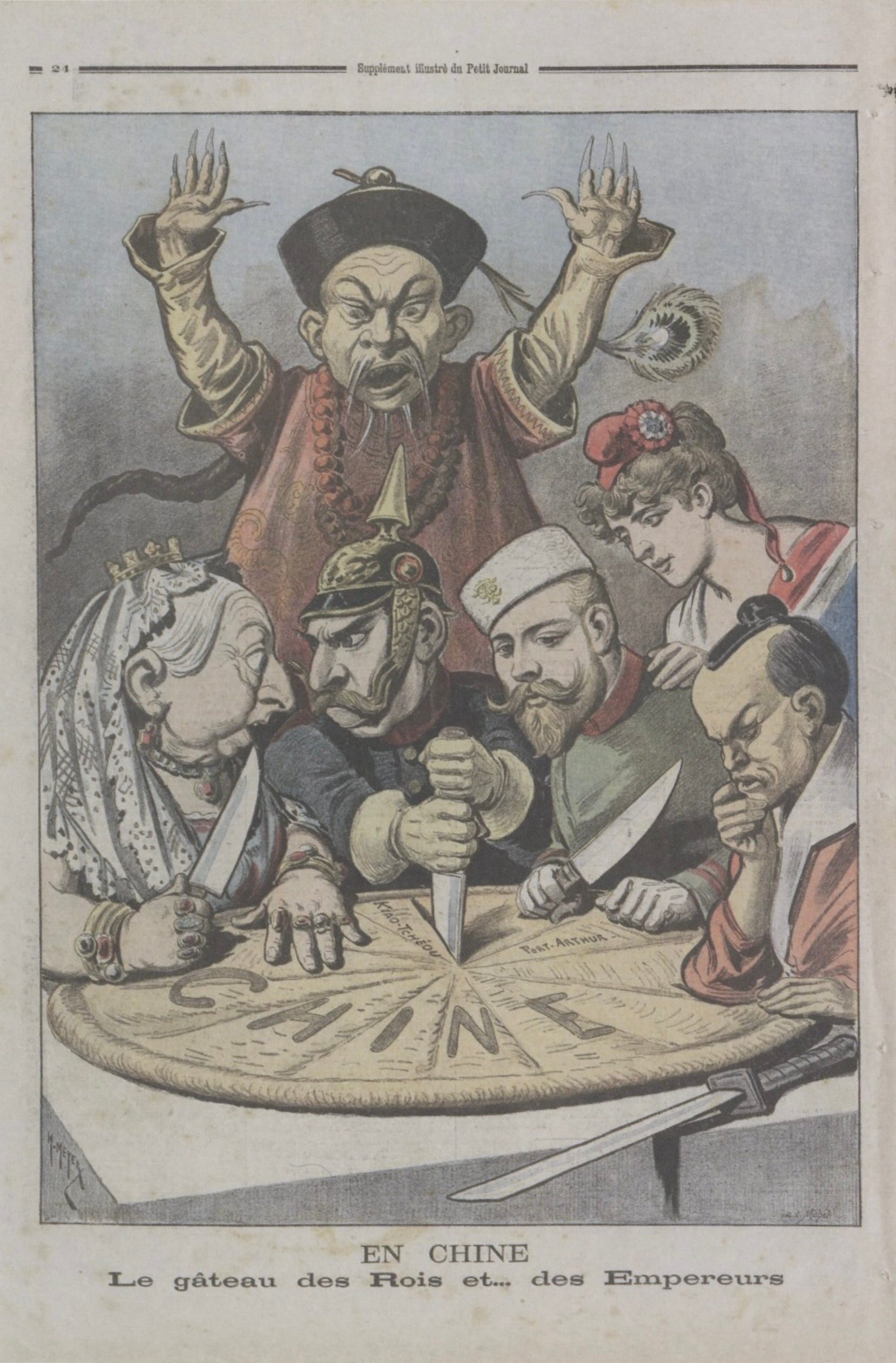
China - The Cake of Kings by Henri Meyer, 1898
What, on earth, could possibly be the common denominator that somehow linked all of those very different pursuits together? Was it, in short, even a thing – and, if so, how?
What I didn’t expect was that the author had long been struggling with the very same question – so much so, in fact, that he nearly didn’t write the book at all.
Exploring Art History is a reader-supported publication. To receive new posts and support my work, consider becoming a free or paid subscriber.
This was a bit of a shock, because if there’s one person you would unhesitatingly conclude would know everything there is to know about illustration, it would be D.B. Dowd, writer, curator, Professor of Art and American Culture Studies at Washington University in St. Louis, and faculty director of its Modern Graphic History Library – a library that, as it happens, is named in his honour. Oh, and he’s a gifted illustrator himself as well.
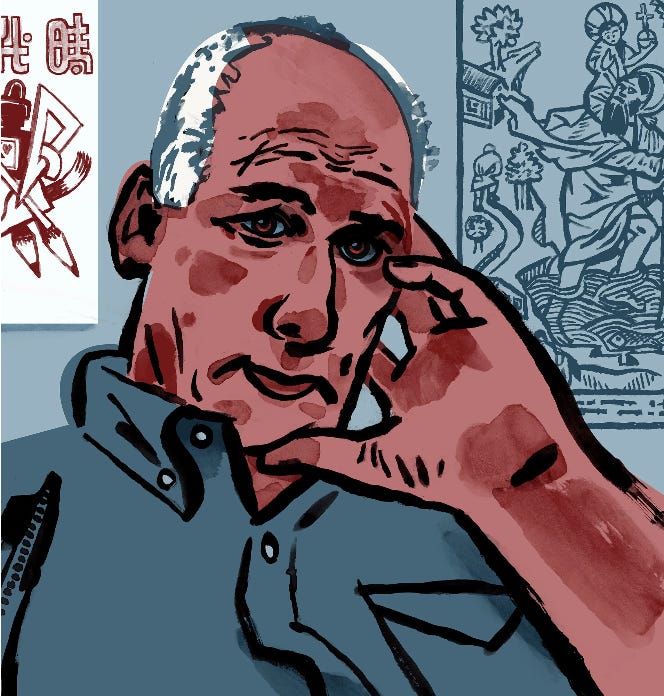
Self-portrait D.B Dowd
And yet, for all of that, Douglas struggled mightily with the very idea of writing a history of the field.
“When I was first asked to write a history of illustration, I said no. And the reason I said no was that I’m really not convinced that illustration has a history. It has a past, but I didn’t feel as if it had developed a historiography. It didn’t have a theory of itself.”
When he was approached again a few years later, he was still hesitant, but this time didn’t reject it outright, instead electing to give the matter some thought.
“For some time I’ve had a kind of abiding frustration with the fact that illustration doesn’t have enough of a literature. And because it doesn’t have enough of a literature, it’s often written about in the context of what it isn’t. It isn’t, for example, a Kantian disinterested aesthetic experience. It isn’t one of the seven Liberal Arts. In fact, its mongrel status seems to be fundamental to what it is.
“So I said to myself, ‘I’m going to think about this for a month. And if I can come up with a thesis after a month, then I’ll agree to do it. And if I can’t, then I won’t.”
During that month of thinking, he found himself reading Alberto Manguel’s innovative A History of Reading – an experience which, as it happens, strongly pushed him towards the light:
“Ultimately, the core aspect of illustration to me is reading. It’s connected to reading. If you’re not reading, it’s just artwork.”
“Just” artwork? Those might well sound like fighting words to followers of Exploring Art History, but Douglas certainly isn’t dismissive of either illustration or the broader notion of art. He’s simply trying to flesh things out, as openly and honestly as he can – a task that, given his unique career trajectory, he’s particularly well-suited to:
“I always knew that I was an artist and a writer, but I wasn’t really acculturated to fine art as a young person: I didn’t take the art history survey, for example. But I also didn’t go to design school and illustration.
“So I didn’t imbibe any of the biases of art, which are quite substantial, nor did I absorb the resentments that have often attended the field of illustration.”
And one troubling consequence of such resentments largely brought about by participating in a domain often minimized or even sneered at by self-proclaimed “serious artists and serious art historians”, Douglas believes, is a widespread unwillingness to take oneself to task for past moral transgressions.
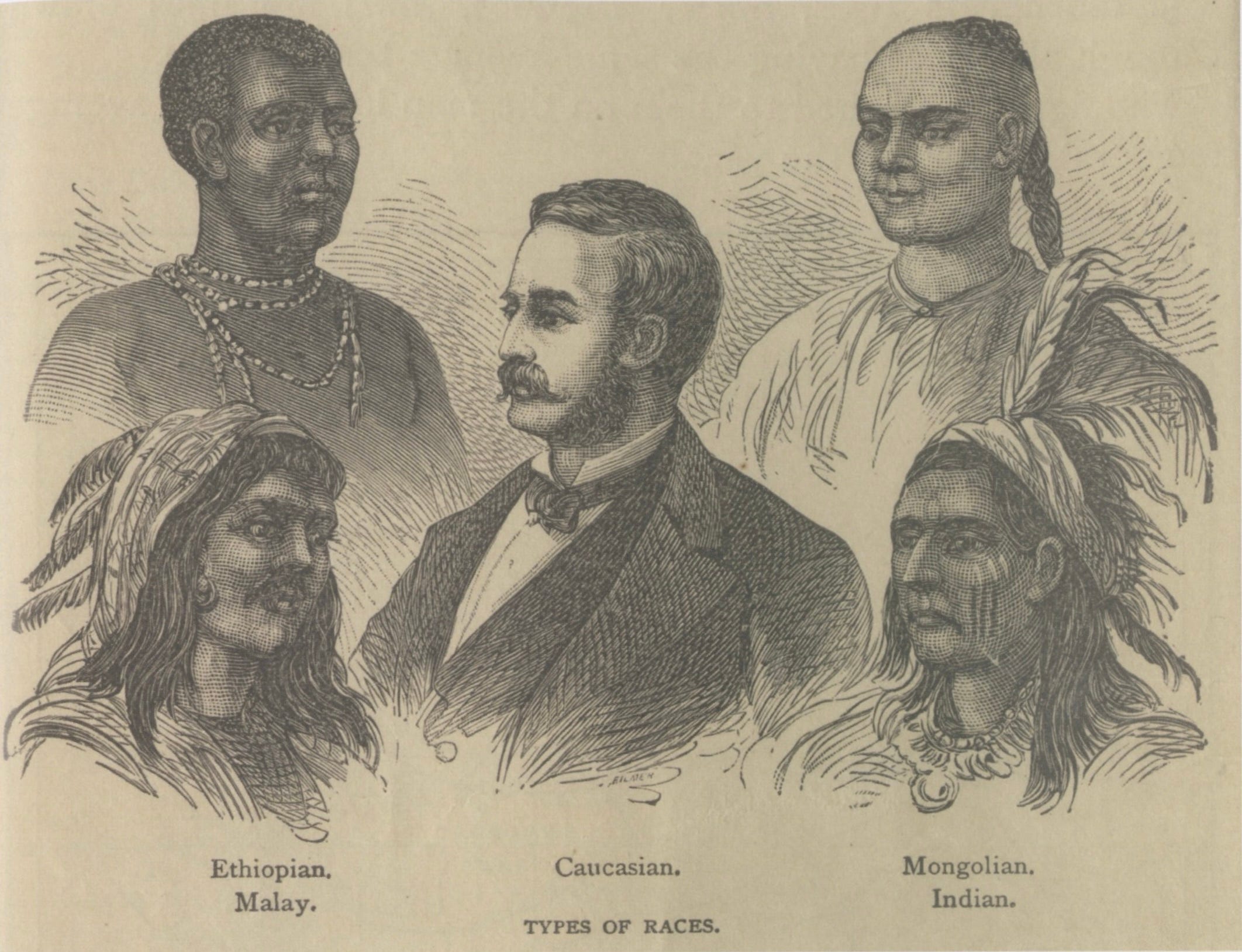
“I think that the boosterism within the field of illustration has often caused it to be less attentive than it might be to the harms that illustration has sometimes been engaged in, like images of the Jews of Europe and the Middle East, indigenous Americans and blacks after slavery.
Matthew F. Maury’s ‘Types of Races’ in his book Maury’s Manual of Geography, 1872.
“There’s a tendency to just kind of wave all that off and say, ‘It would be better if we didn’t have to look at that.’ But it’s important to realize that the very cultural impact of these depictions occurs because illustration is invisible. It doesn’t have the status of art. You don’t look at it and stroke your chin. You just absorb it.”
In Leo Tolstoy’s famous essay, What is Art?, he defines art not through standard aesthetic criteria, but by its capacity to invoke an emotional response, with “good” art distinguished by its ability to generate morally elevated sentiments that, “replace lower feelings, less kind and less needed for the good of humanity, by kinder feelings, more needed for that good.”
By Tolstoy’s criteria, illustration is art1 but rarely good art. For D.B. Dowd, meanwhile, illustration shouldn’t be regarded as part of the formal domain of art history at all; its proper place is squarely within cultural history.
It makes you think.
Which is the whole point.
Howard Burton
Below you can watch my recent conversation with D.B. Dowd.
For your convenience we have embedded the podcast video below. We’ve produced carefully edited English subtitles that are the basis for all translated captions on YouTube. If you’d like to watch on your laptop, please click on “Watch on YouTube” on the cover below to activate the subtitles.