

On Aesthetic Judgements
An untethered ramble

This post, I should warn you at the outset, will likely ramble all over the place. Of course, I don’t know that for a fact – I’m only just beginning it, after all – but I strongly suspect that it will, not least of which because my mind is going in several different directions simultaneously as I write these words.
Regular readers of Exploring Art History might not be the slightest bit surprised by this, given my penchant for bringing in widely different, seemingly stream-of consciousness, reference points – like starting a post on Linda Nochlin’s celebrated 1971 article launching the discipline of feminist art history with a description of my shock when first encountering Einstein’s 1905 paper on special relativity.1
Some might view this as pretentious, or a paean to “interdisciplinary” values (or, of course, both). But it is neither. As someone who’s spent a good chunk of his life ruminating over scientific issues (both personally, and as a practicing sociologist of science for the better part of a decade),2 I naturally make links between different aspects of my past experiences. If these sometimes seem a bit more of a stretch than most, it’s simply because of the curious nature of my personal career trajectory – I never imagined that I would somehow end up spending my days making films on different aspects of art history – but life is full of surprises for all of us.
As far as interdisciplinarity goes, well, it’s not a word that I’ve ever been a fan of (indeed, I’m not even entirely sure that it is a word, but that’s a rant for another day), as it’s long struck me as one of those typically semantically bankrupt terms that academic administrators regularly trot out to sanctimoniously reaffirm their self-proclaimed “vision”. 3 But what could it possibly mean? A closer examination quickly reveals: not much. Because in order for an action to be truly “interdisciplinary”, it must, tautologically, transcend prior “disciplinary boundaries” – thereby somehow linking (or at least shedding valuable light on) two or more areas previously considered to be “in fundamentally disparate silos”.
Well, who, in his right mind, would believe that such “fundamentally disparate silos” are anything more than unreflective limitations of our world views, anyway? After all, that is precisely what we mean when we talk of someone making a great discovery – that he or she has found a way to meaningfully link two things together that for a long time appeared to have little to do with one another.
Here’s a revealing example from the history of physics. For centuries, everyone knew that two key terms invoked in our mathematical description of moving bodies, so-called “inertial mass” and “gravitational mass”, magically appeared to possess the same value, despite the fact that they reflected two very different processes – one associated with the law of inertia and the other associated with gravitational attraction. But it was left to Einstein (yes, Einstein again) to make the vital conceptual leap by postulating a deep, fundamental equivalence between the two, thereby setting the stage for the flowering of the general theory of relativity, unquestionably one of the single greatest accomplishments of our species.4
What shall we call Einstein’s insight? A probing act of interdisciplinary research overcoming the previously established divide between general Newtonian dynamics and his gravitational theory? Of course not; see how silly that sounds? For me, he was simply engaging in an explicit act of rethinking, a deliberate paring away of decades, sometimes centuries, of accumulated biases and assumptions in order to make a new start, to re-imagine an “established” picture anew.
The main problem with embarking on such a deliberate practice of comprehensive rethinking is that it is extraordinarily difficult – requiring an unrelenting desire to rigorously inform oneself of all the subtleties of our current understanding while investigating a wide range of prospective new ideas and interpretations, necessarily leading the researcher well outside of any reasonable comfort zone. It is, in other words, hardly something that can be brought into being simply by announcing some shiny new “interdisciplinary research program”.
It is a question of character: a willingness to constantly probe one’s own beliefs and assumptions so as to develop deeper and more profound insights. A few have it. Most don’t.
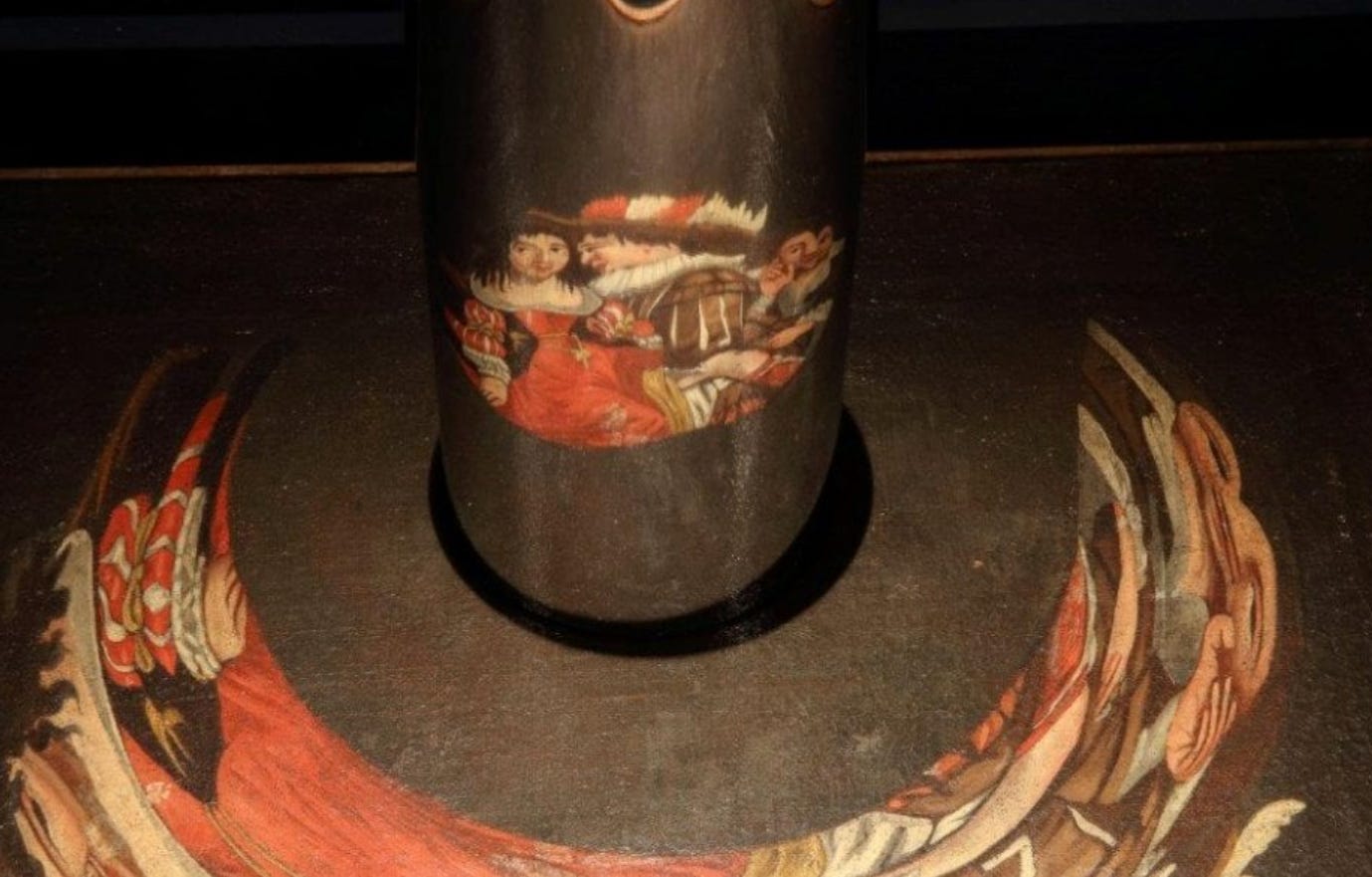
Which brings me, in my own meandering way, to Susanna Berger, Walter Burke Associate Professor of Art History at Columbia University. Susanna has recently published The Deformation: Attention and Discernment in Catholic Reformation Art and Architecture,5 one of the most stimulating books I’ve read in a long, long time. Weaving together visual theory, literature, intellectual history, and much, much more, The Deformation describes in compelling detail how many deeply sophisticated, often illusionistic works of 17th-century art and architecture were explicitly constructed in accordance with an overarching religious philosophy that required them to be actively “reformed” into clarity by the discerning viewer. It’s a truly fascinating thesis, all the more so for someone like myself who knew absolutely nothing about this subject before opening the book.
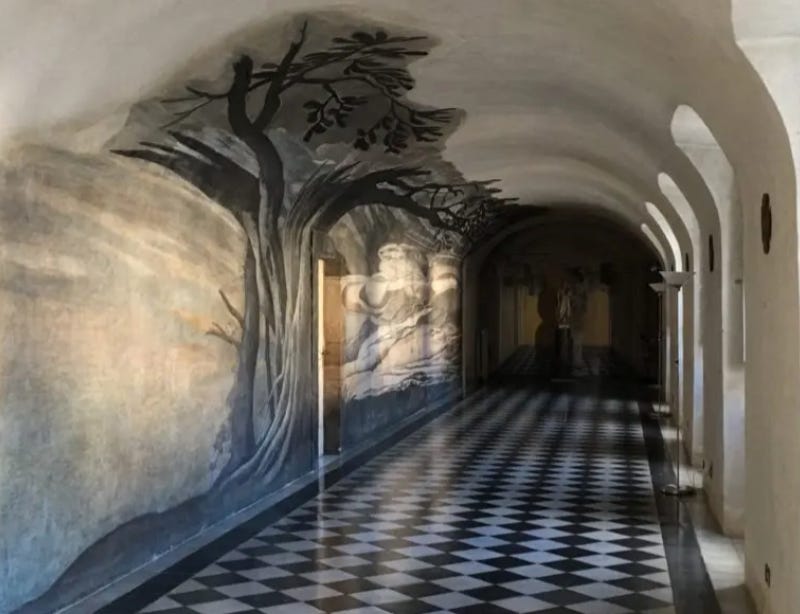
The broader domain of artistic perspective in which the book is naturally placed, however, is something I’ve long been attracted to – with its intriguingly overlapping strands of art history, mathematics, optics and cognitive science combining to provoke an almost limitless number of deep, foundational questions about the nature of both representing, and beholding, the external world.
Given the breadth of its subject matter, The Deformation will surely be trumpeted by at least some of its supporters as “interdisciplinary” – thereby, I’m convinced, damning it with some pretty faint praise. Far better to just call it what it is: a deeply thoughtful and incisive work very much in the tradition of some of the most penetrating pioneers of art history, such as Martin Kemp and Erwin Panofsky – scholarly precedents that Berger naturally invokes on a regular basis, to the reader’s manifold benefit.
Because that’s another thing that such illuminating works do: they repeatedly direct you to celebrated precursors that you should be familiar with, and sometimes even convince yourself that you are, but often turn out not to be.
So it turned out to be with Panofsky’s groundbreaking 1956 article, “Galileo as a Critic of the Arts” that was frequently cited at key moments throughout The Deformation.6
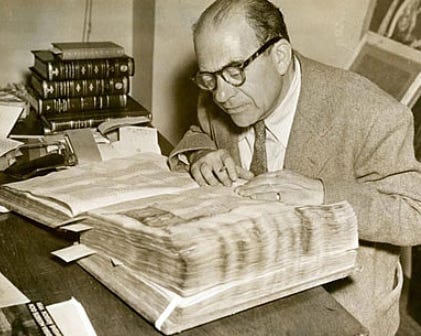
I don’t have a background in art history, and so have no easy way of assessing to what extent today’s art history students are genuinely aware of Panofsky’s ideas, but I can unhesitatingly declare that they most certainly should be. Of course he has long been firmly ensconced in the art historical pantheon as one of the greats of the field, but in my experience familiarity with a name is not the same thing as familiarity with the actual writings. For my part, I’d read some of his work on Dürer, and was familiar with some of his essays, such as the highly intriguing, “Perspective as Symbolic Form”, but had never come across “Galileo as a Critic of the Arts”, and found myself naturally intrigued by the title.
I knew that Galileo came from a humanist family (his father was a highly regarded musician and music theorist) and that he expressed many of his key research insights through the trendy literary form of a Renaissance dialogue, but all of that, I assumed, was simply a form of “cultural window dressing” for someone whose driving motivations were exclusively scientific in nature.
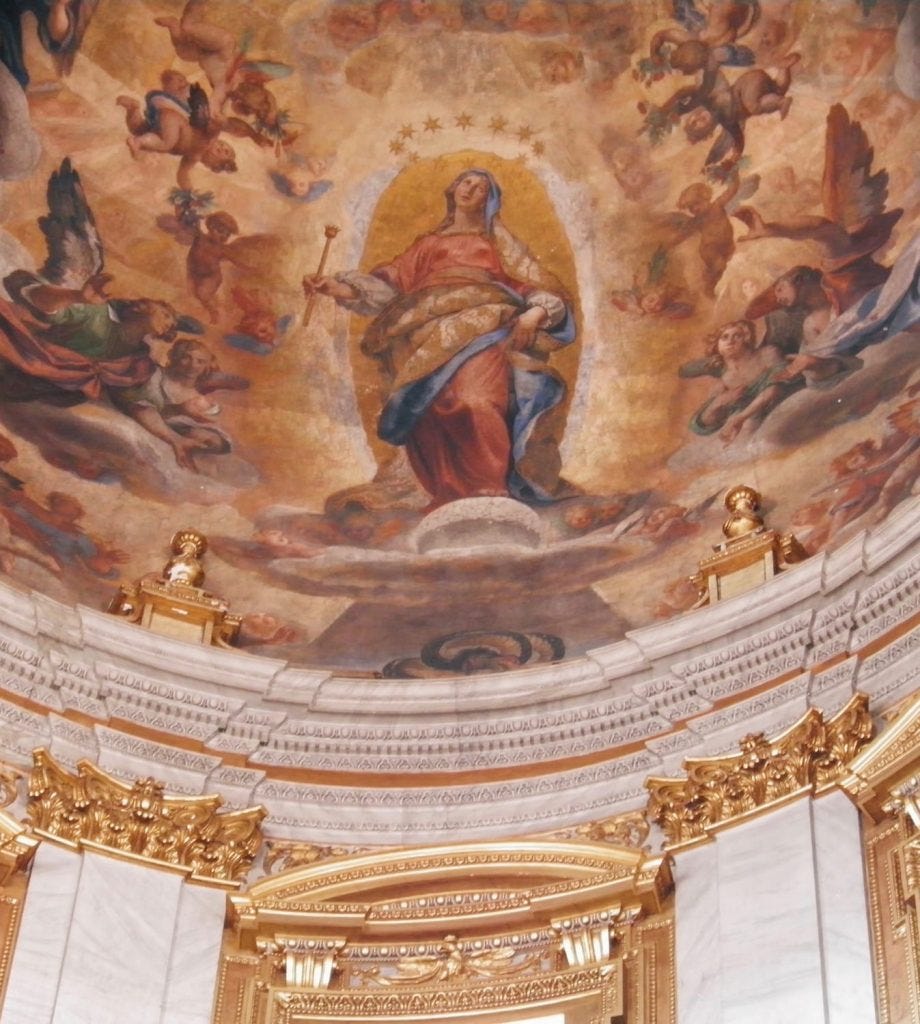
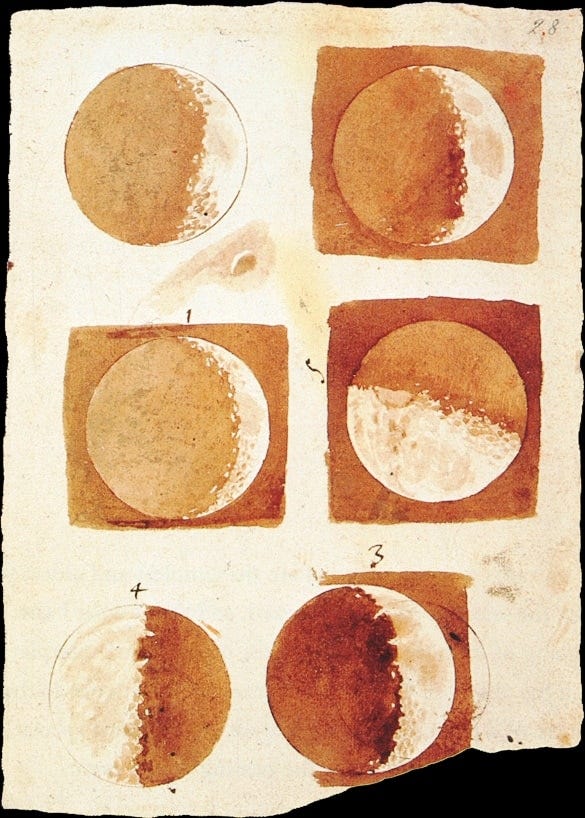
Well, not necessarily, it turns out. Panofsky begins his piece by informing us that, while it was “well known” that Galileo was a huge fan of the influential poet Ludovico Ariosto and a scathing critic of his later contemporary Torquato Tasso (”well known” to him and his circle, presumably, but certainly not to me), he also had strong views on “other arts”, and was close friends with the Florentine painter Lodovico Cigoli, who had famously (again, not to me) incorporated Galileo’s realistic depiction of the moon seen through the telescope in his Assumption of the Virgin fresco in the dome of the Pauline chapel in the Roman church of Santa Maria Maggiore.7
So that was all very interesting, in the general “spot the influence” sort of way that is the stock and trade of any good art history tour guide.
But Panofsky, typically, went far deeper than simply pointing out how Galileo’s research might have naturally rubbed off on his painterly friend. His main focus was to depict core aspects of Galileo’s “aesthetic judgements” – judgements which, he claimed, could be directly traced to his scientific orientation.
In particular, aside from his virulent antipathy towards Torquato Tasso’s poetry, Galileo was also strongly disparaging of the contemporary trend of “illusionistic art”, such as the “anamorphoses” that Susanna Berger extensively tackles in The Deformation: carefully constructed images that can only be “resolved” when looked at from specific angles, such as the famous skull (that one I did know about) between the two figures in Hans Holbein’s National Gallery painting, The Ambassadors.
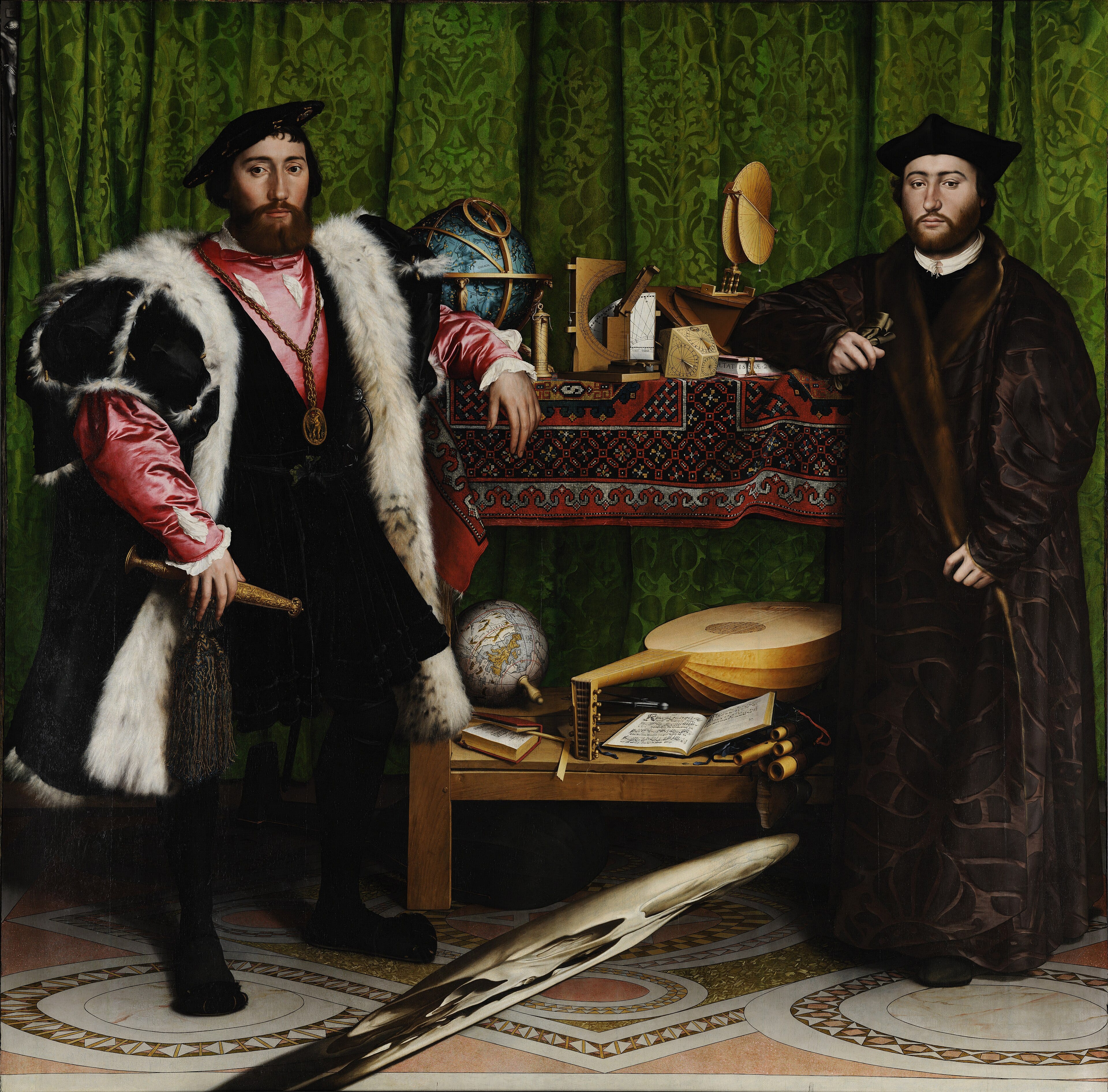
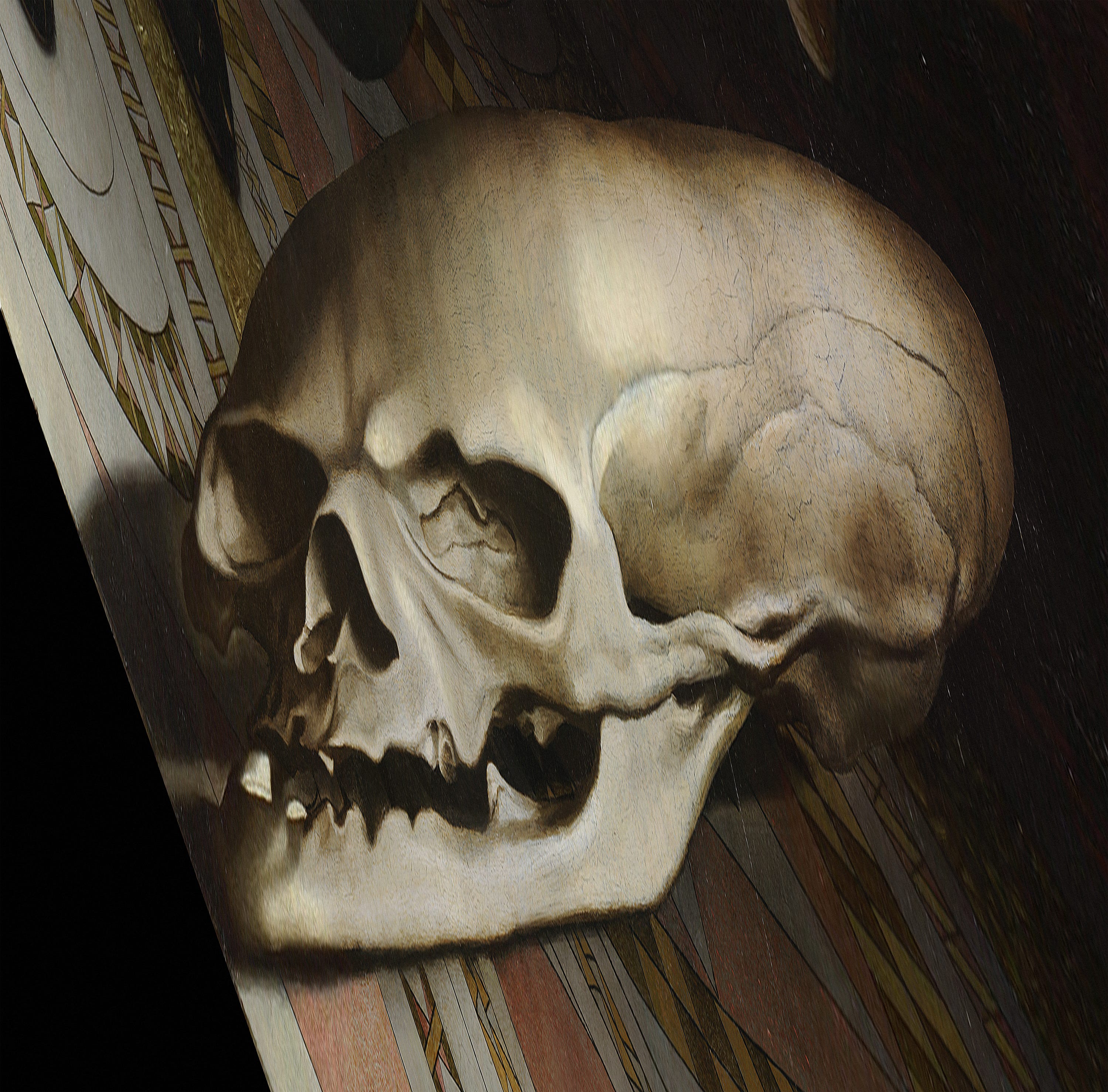
Well, everyone likes to have strong views. But Panofsky’s point is not so much that Galileo was an opinionated fellow, but that his disdain for such perspectival illusions was very much of a piece with his irritation at Tasso’s continual allegorical bombardment throughout his poetry, where nothing was what it seemed and so much was forced to somehow represent something else.
That was both illuminating and eminently comprehensible. Here was Galileo, the shining exemplar of a bold, new scientific “tell it like it is” realism, naturally repelled by any fancy-pants diversions that might direct our attention away from the coolly detached investigation of nature that we now identify with being necessarily associated with genuine scientific progress. So much, so expected.
But then it got really interesting. Because Panofsky’s point isn’t simply that all of that shape-shifting artistic trickery of the age naturally clashed with Galileo’s straightforwardly empiricist temperament, but that things were vastly more subtle, given that Galileo’s actual temperament was hardly as “straightforwardly empirical” as modern scientific lore currently maintains (think of the timeworn image of him dropping balls from the Leaning Tower of Pisa, which, in fact, he almost certainly never did).
In particular, Panofsky (now effectively teaming up with the equally impressive historian of science Alexandre Koyré) asks the provocative question of why Galileo so resolutely ignored Johannes Kepler’s discovery of the planets’ elliptical orbits throughout his entire life. Such behaviour hardly smacks of what anyone might reasonably associate with “a diehard, straightforwardly empirical temperament”.
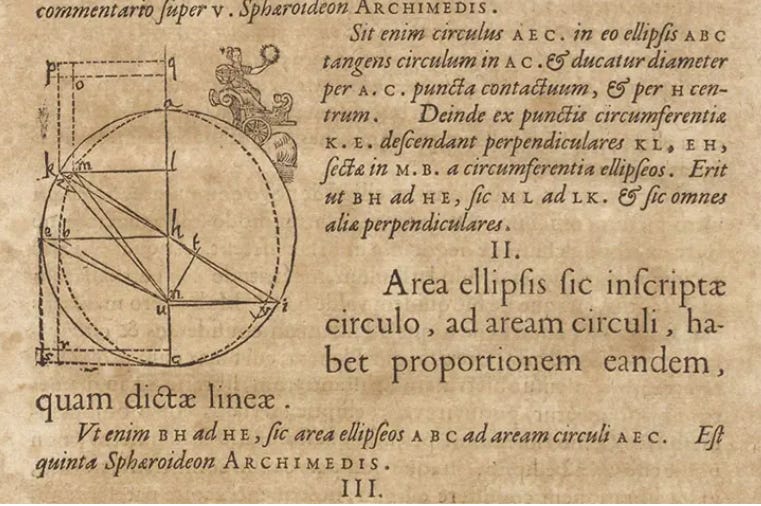
Indeed, the answer, according to Panofsky and Koyré, seems to be that Galileo rejected Kepler’s conclusions because they didn’t square with his flagrantly a priori convictions that, at its heart, all motion – including, incidentally, all motion of humans and animals (a view independently purported by Leonardo da Vinci over a century earlier), was necessarily based upon systems of circles – a shape long believed throughout history, due to its pleasing symmetry properties, to be the “naturally perfect” form. Ellipses, in other words, were “deformed circles”, and thus couldn’t possibly represent the ultimate, underlying expression of real physical movement.
Well then, you might conclude, it must have been Kepler who was the “straightforward empiricist”, given his willingness to accept non-circular orbits. Not really, says Panofsky (and Koyré). Kepler was a product of the old, medieval Platonically-inspired philosophy that happily accepted that real objects, mired as they are in the imperfect physical realm8 might well deviate from their ideal trajectories due to the presumed impact of their corruptible, earthly material, while Galileo, modernist that he was, emphatically rejected the existence of such an ideal ethereal world to begin with.
To Galileo the real, physical world was all there was. But that hardly meant that the appropriate way to describe it didn’t involve a particular, circumscribing, aesthetic orientation – one that, as Panofsky so revealingly demonstrated, was also strongly represented in Galileo’s approach to literature and art.
Fascinating stuff. But to me, at least, the story doesn’t end even there. Because as tempting as it might be to position Galileo, “Early Modern” fellow that he was, as “a key figure in the slowly emerging scientific worldview naturally tainted with the prejudices of his time”, it’s well worth asking to what extent scientists today approach their subjects with particular “aesthetic orientations” representing specific a priori beliefs.
To what extent, for example, might a modern theoretical physicist be willing to ignore the notion of gauge invariance – or, even more generally still, an underlying action principle? That is not to say, of course, that these are blind, arbitrary prejudices, akin to naively believing in the power of circular symmetry – they are clearly not. They are invoked, now almost always unthinkingly, because history has shown that they have worked remarkably well.
But they are aesthetic judgements all the same.
Howard Burton


And as I say this as a former academic administrator myself who’s publicly invoked it on several occasions.
Unquestionably? Yes, unquestionably. Not everything is up for debate. Strident relativists (terrible choice of word in this instance, of course, but you know who you are) should unsubscribe immediately.
2025, Princeton University Press.
See here, for example, for a version of this paper. It is an abridged and revised version of an earlier “pamphlet” produced two years earlier, that was designed as a summary of an intended 1955 lecture that was never given due to illness.
Which is often called, particularly confusingly so in this case, the “sublunary realm” – but that is one digression too many even for this post.
I read a book in high school European History class about the Enlightenment, and it discusses the astronomical drama (i.e. the drama with geo to heliocentrism, Galileo's work, etc.) I just can't remember the title or the author. It seems that there's a constant struggle between empirical scientific methods and the mystical belief-(or fear)-based religions.