

Visual Enlightenment
The benefits of opening your eyes

One of the constant challenges faced by someone like me, an outsider who’s recently plunged into the vast and often intimidating art historical universe, is simply getting the balance right between the art and the history.
While no more a historian than a visual specialist, I nonetheless find myself naturally drawn to larger conceptual investigations, searching for meaningful connections across time, space, people and ideas. So it is that I’ve written pieces highlighting confusing and often deeply unhelpful art historical terminology (Gothic Gobbledygook), questioning commonly accepted motivations of powerful art patrons (Slandered By History) and exploring the extent to which the act of popularizing art history is different from its scientific counterpart (Multi-Layered Illumination).
Even when I dove into specific works, such as the famous mosaic floor of Siena’s cathedral (Syncretic Brilliance), I found myself focusing on larger, overarching themes – like how a genuine sense of artistic consistency was somehow able to be maintained over 500+ years – rather than detailed examinations of the art itself.
In last week’s piece, A Curious Conversion, I discussed how the ancient oracular Sibyls were subtly transformed into harbingers of Christ and widely incorporated throughout Renaissance sacred spaces, concluding with – yet again – the famous pavimento of Siena’s cathedral, with its depiction of all ten Varronian Sibyls.1 But I never focused on their actual images.
That should change; not just because something called Exploring Art History really ought to be paying attention to artistic particulars, or even because learning to look closely is an essential aspect of the entire enterprise, but because very often our principal way into appreciating a work of art in all its aesthetic, sociological and historical splendour, is precisely through its uniquely captivating details. We may be told that something is “significant” or “important”, but it invariably doesn’t resonate with us personally until we lock on to some particularly engaging aspect of it that speaks to us directly. All the panegyrics about Botticelli’s “famously undulating line” mean very little unless we find ourselves thinking, Oh yes, that wonderful flowing hair!
So let’s take a moment to look a little closer at those Sienese Sibyls.
Each of them is standing, full-length, as if a statue, labelled by a faux-pedestal inscription (the Erythrean and Cumeaen Sibyls have their identifying inscriptions to the side), beside a corresponding Latin oracular utterance, most of which are taken from Lactantius’ influential Institutes Divinae that was highlighted in last week’s post.
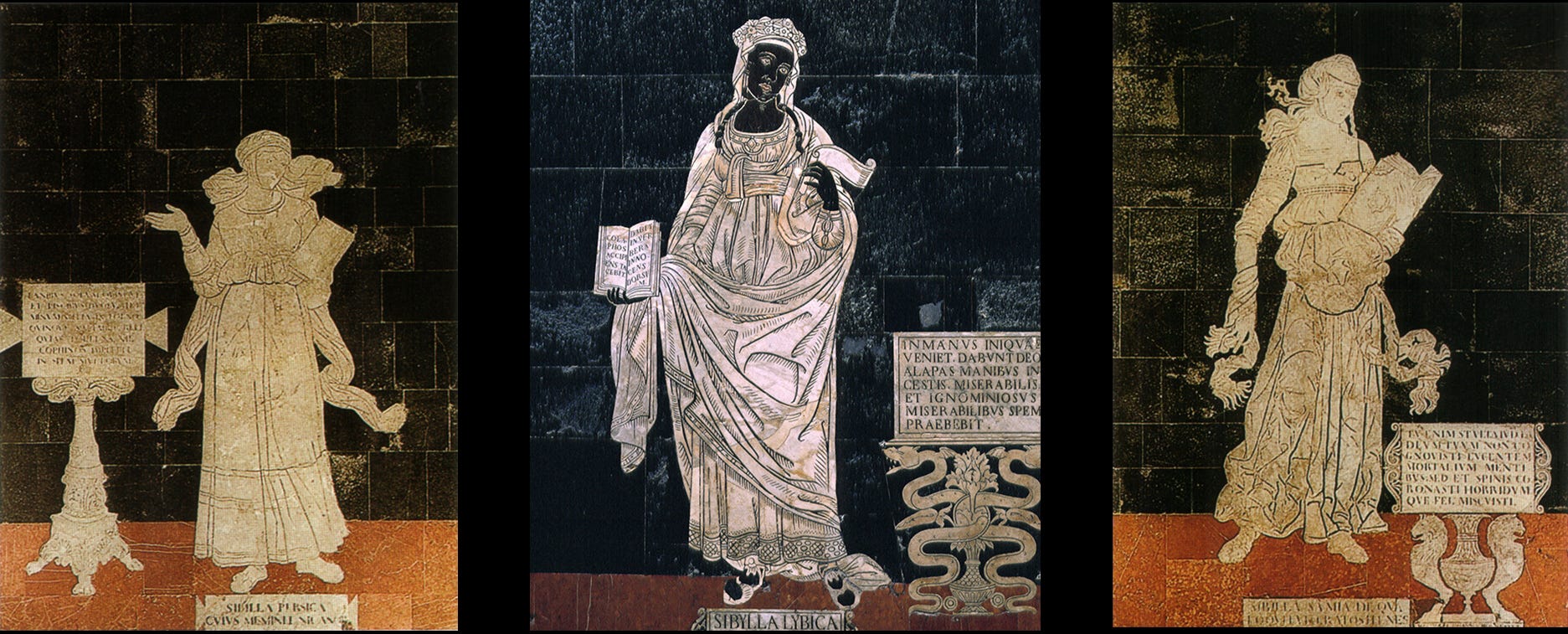
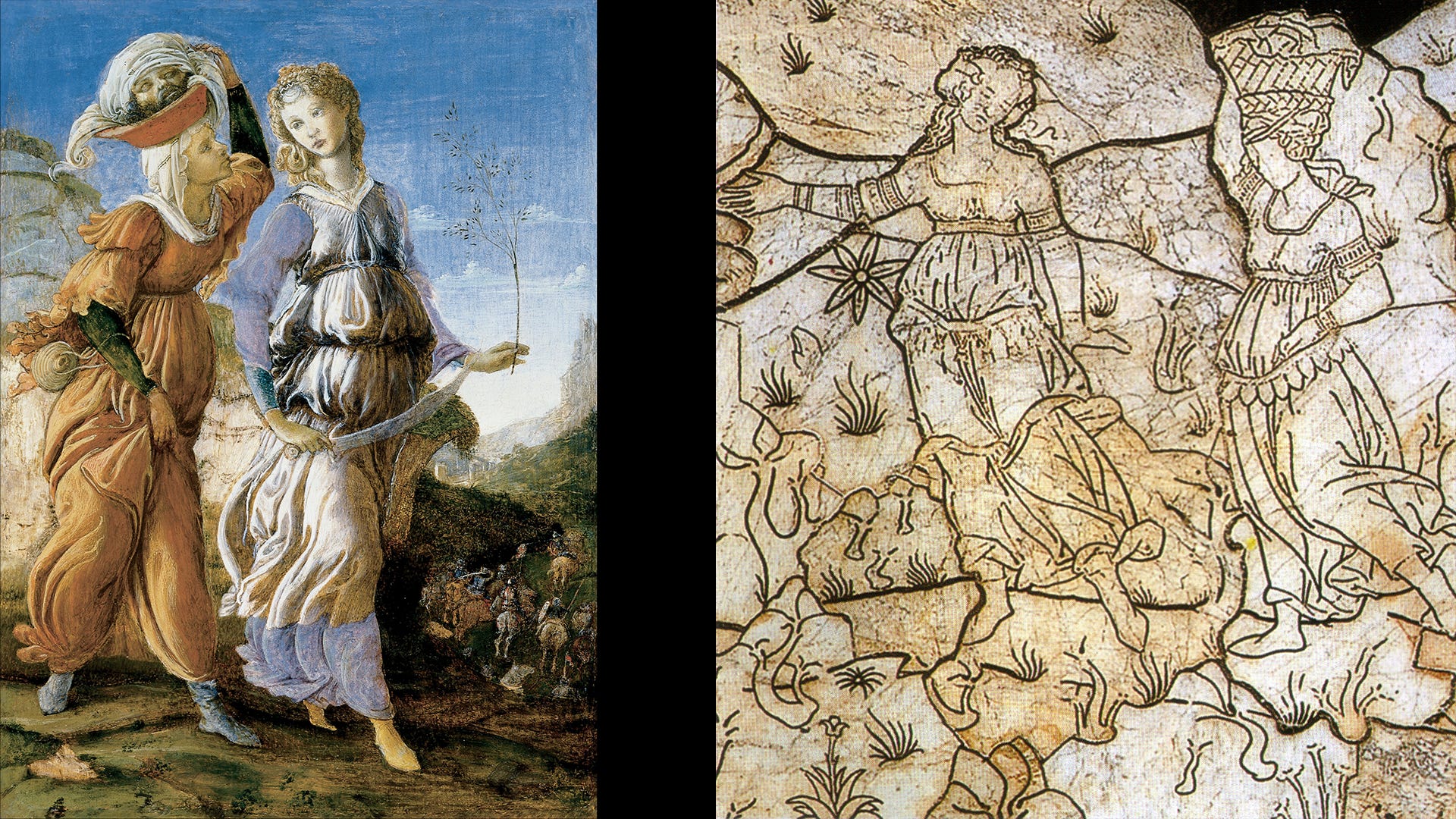
The Sibyls are all beautifully constructed and, like many of the images on Siena’s pavimento, are often strongly reminiscent of Botticelli’s aforementioned undulating line – which may not be as much of a coincidence as it otherwise appears, as can be seen from the striking similarity between another contemporaneous pavimento mosaic of Judith and her maid by Francesco di Giorgio Martini and a Botticelli painting of the same subject created a few years earlier.2
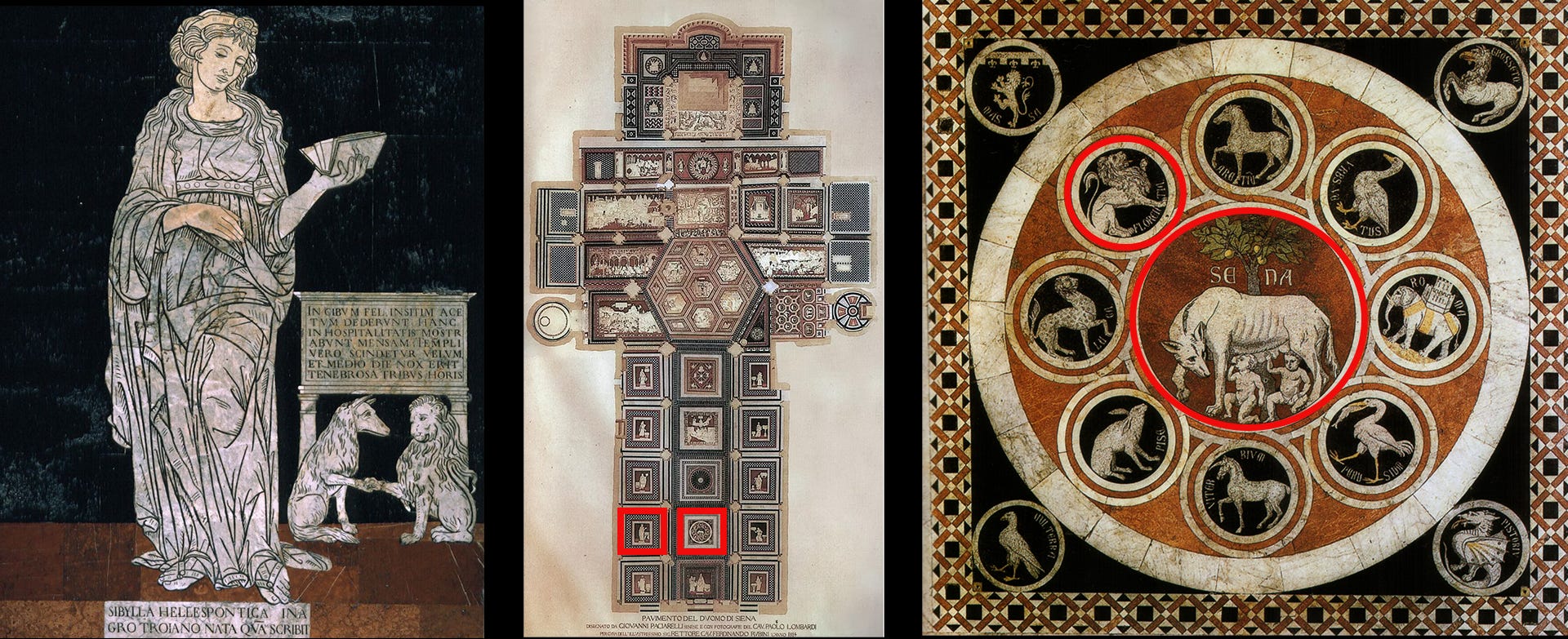
For me, however, the most arresting Sibyl-related image is one which doesn’t seem to have much to do with depictions of those ancient priestesses at all: the beguiling image of a wolf and lion embracing under the prophecy of the Hellespontine Sibyl. What, on earth, is that all about?
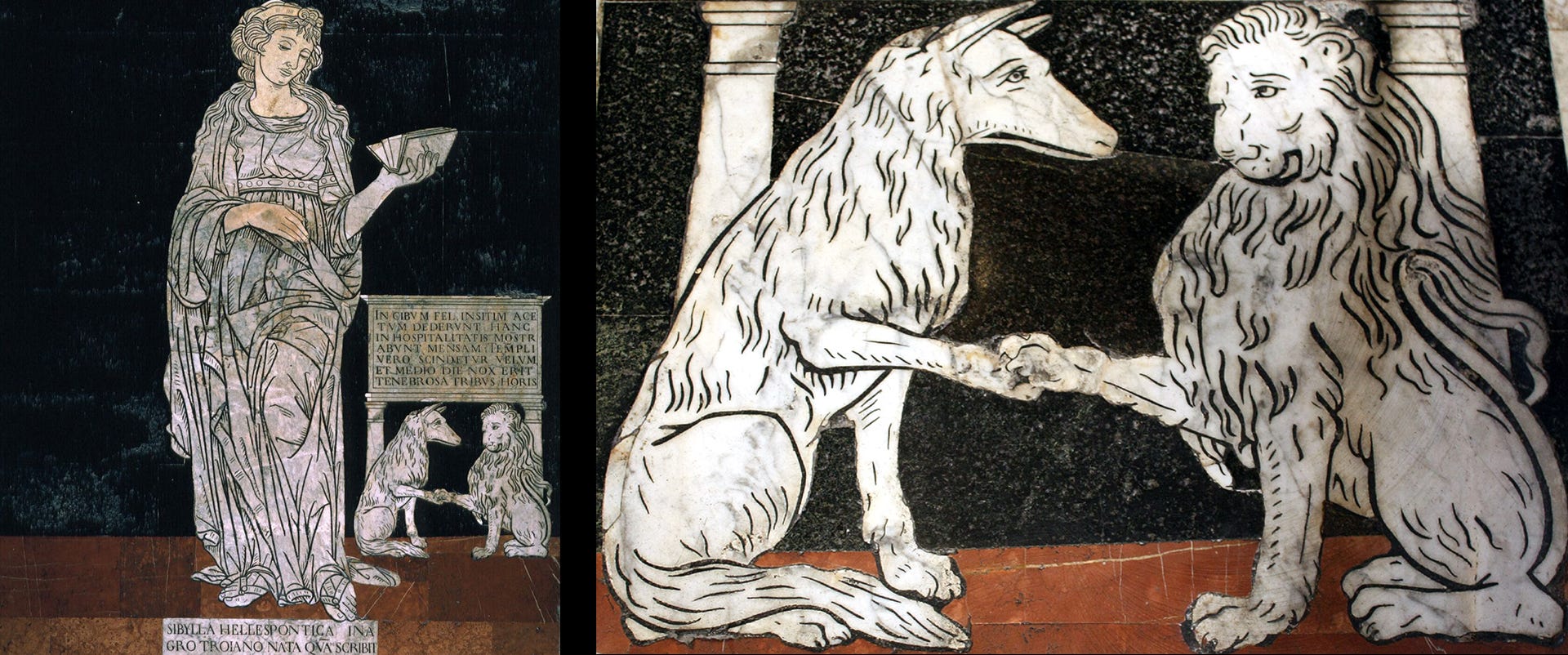
Well, as you might imagine, there are a variety of different views. One is that the reconciliation between the wolf and the lion is a metaphor for how the Jews and Romans united to condemn Christ, in keeping with the line in Luke (23:12): “That very day Pilate and Herod became friends with each other, after having previously had been at enmity with each other.”
This interpretation has the advantage of being directly related (more or less) to the Sibylline utterance inscribed above the embracing animals, which describes how during the crucifixion Christ was given vinegar and gall to quell his thirst and hunger.
But it doesn’t particularly convince me.
In the first place the iconography is a bit suspect. Jews are indeed referred to as lions in Genesis 49:9, but the Romans (see Matthew 7:6 and 15:26) are represented by a dog; and what we’re looking at here is pretty clearly a wolf, not a dog.3
Much more relevant to me, however, is the fact that – in keeping with my new image-focused outlook – there is something undeniably endearing about the remarkable visual entente between the wolf and the lion: a picture that seems flagrantly inappropriate to represent the alliance of those who’ve joined forces to murder the Son of God.
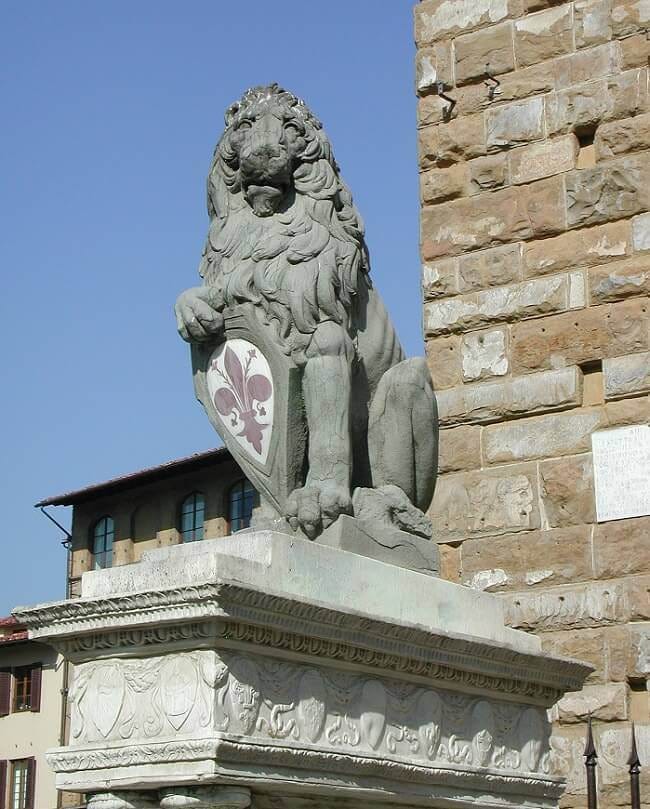
And, as it happens, there does seem to be a much more congenial symbolism we could choose for this image: the on-again, off-again peace negotiations between Siena and her principal rival Florence, with some maintaining that what we’re seeing here is a reflection of the latest peace treaty between the two – as we’ll shortly see, Siena is customarily depicted as a wolf, while Florence is often represented by the lion, or Marzocco.4
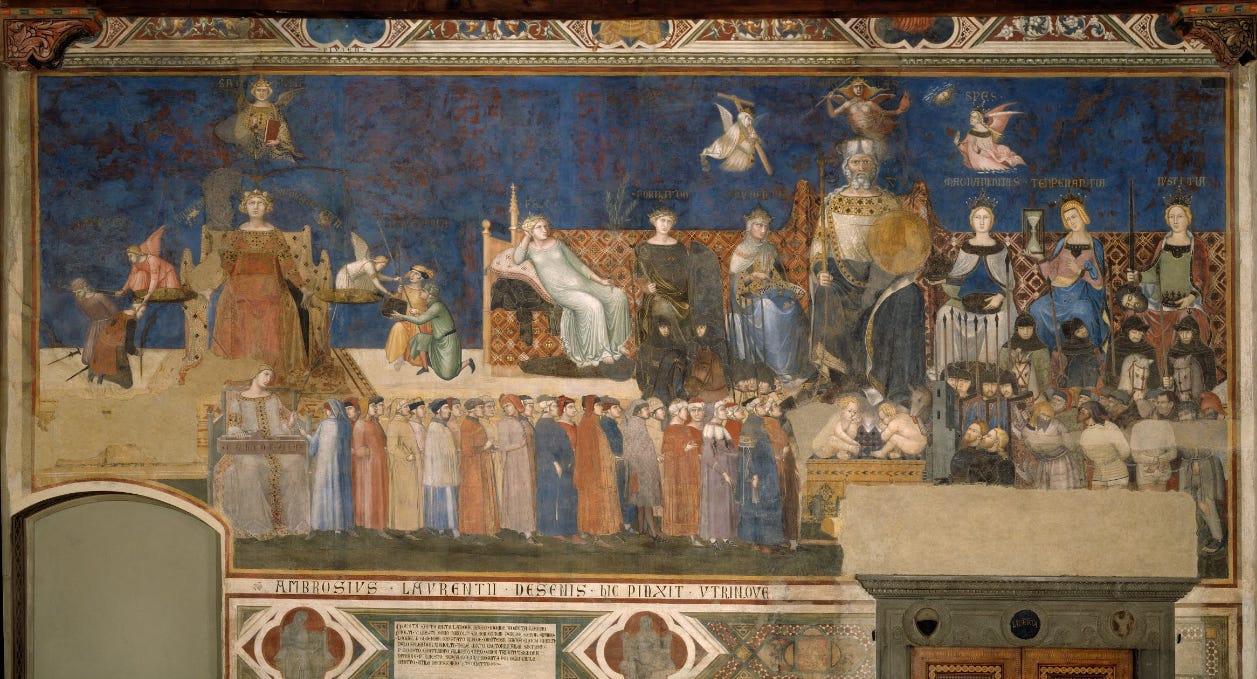
While it’s not entirely obvious why a depiction of the Hellespontine Sibyl is the ideal location to celebrate this contemporary political development,5 it’s worth pointing out that there are several notable precedents in Sienese art to celebrate the merits of peace with one’s neighbours, such as Ambrogio Lorenzetti’s Allegory of Good Government, with the figure of a prominently-displayed Peace calmly reclining in the centre,
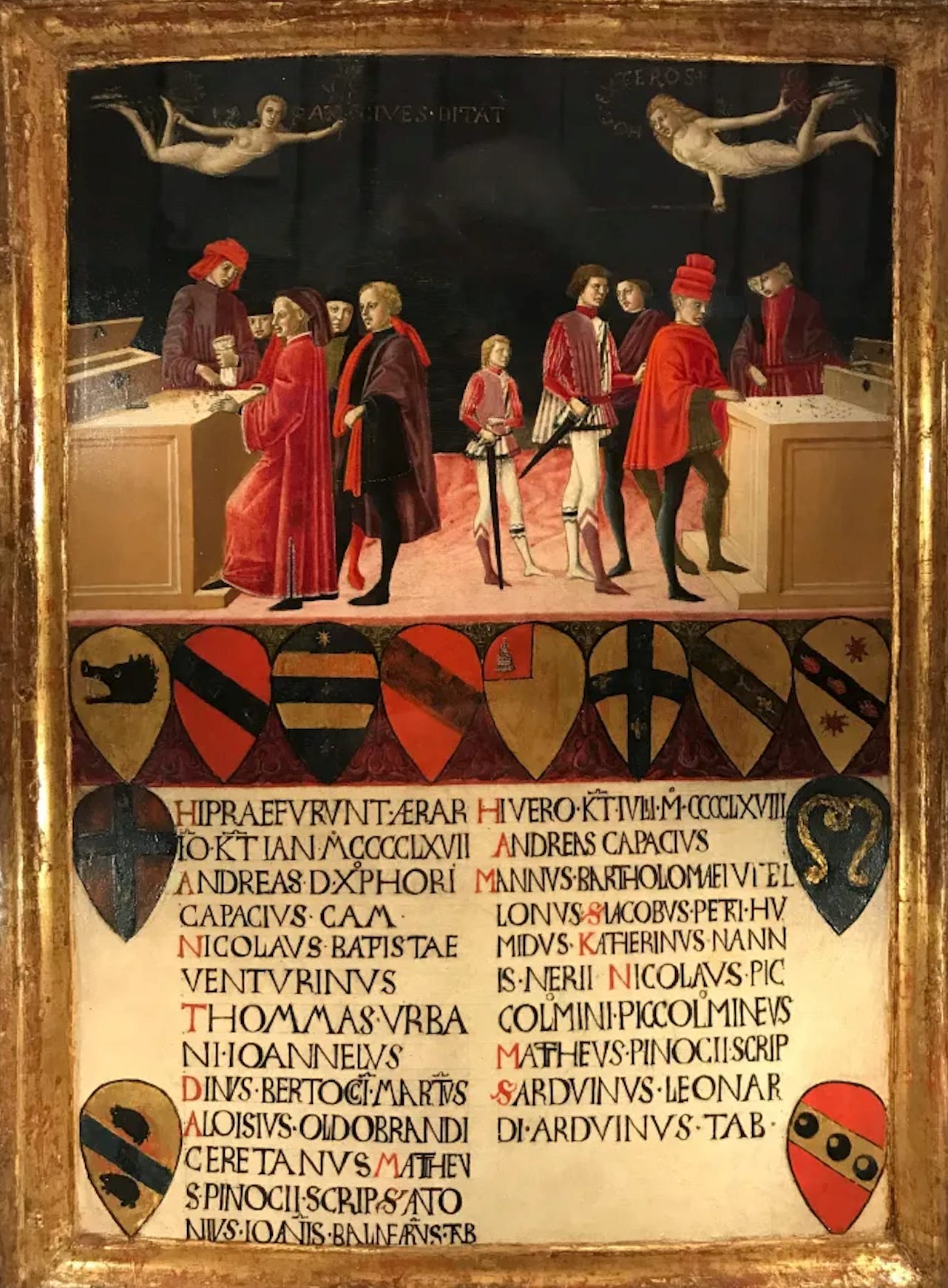
and Benvenuto di Giovanni’s Finances of the Commune in Times of Peace and War, showing the stark social contrast between peacetime and wartime.
And then – most significantly of all – it must be recognized that there’s another marble floor mosaic directly adjacent to the Hellespontine Sibyl, where the iconic Sienese wolf and Florentine Lion (among others) are explicitly referenced.
Coincidence? I think not.
See how important it is to look closely?
Howard Burton
We’re currently producing a detailed video on the mosaics of Siena cathedral’s pavimento as part of our Art In Focus series on our new Exploring Art History YouTube channel, where we’ll soon be releasing weekly video podcasts with accomplished art historians and other art experts as well. Subscribe now to receive updates!
For readers fed up with my current obsession with Siena’s duomo and its celebrated floor mosaics, I’ve got some bad news for you: I’ve only just begun. If you feel that way, best to give this substack a pass until the end of March, when I’ll start writing different sorts of pieces related to our upcoming podcasts.
For this, and many more intriguing aspects associated with this topic, see Reba Ann Gibb’s 2003 University of Warwick PhD thesis “A Study of the Early Renaissance Sibyl Cycles in the Art of Northern and Central Italy”.
Of course, those sticking to their iconological guns here can always invoke the wolf that suckled Remus and Romulus, but that seems a pretty significant stretch here in my view.
For those understandably wondering how it’s possible that Siena managed to have somehow co-opted the famous Roman myth of the she-wolf suckling Remus and Romulus, it’s because the mythology underpinning the city’s origins relates that it was founded by the two sons of the ill-fated Remus, Senio and Ascanio, who fled the Rome of their murderous uncle to come to what later became Siena, bringing the famous she-wolf symbol with them.
One iconological justification occasionally made is the claim that, since the Christian customarily embraces his neighbour before receiving communion, a peaceful embrace is in keeping with the reference to a sort of holy nourishment referenced in the text.
Thank you for this insightful analysis! Looking closely is always the best way to connect with an artist. Details are generally where they put their heart and personality, beyond the broader aesthetic canon.